


2026 CFD Platform Comparison: A Review of Publicly Available Information on Slickorps and Eight Other Platforms

Choosing a contract for difference (CFD) platform involves more than selecting an order-entry interface. It also determines trading costs, available leverage, and the regulatory protections applicable to client funds. Two platforms may both advertise spreads from 0.0 pips, yet their actual costs may differ severalfold. The difference may lie not in the spread column, but in the commission column. Another frequently overlooked issue is the contracting entity. The fact that a brokerage group holds six licenses does not mean a trader account is simultaneously protected by six regulators. The actual protection comes only from the entity with which the client enters into an agreement when opening the account.
This article applies consistent criteria to organize publicly available information on nine CFD platforms: Slickorps, Pepperstone, MIFX, OANDA, IG, CMC Markets, eToro, Vantage, and Blueberry Markets. It also explains six areas that users can review individually when selecting a platform. This article does not rank the platforms. It only compiles public information to help users understand the differences among the platforms in terms of products, regulation, and trading conditions. All data is sourced from the official webpages and regulatory registers of platforms and was verified as of September 30, 2026. Trading conditions may change at any time. Before opening an account, users should refer to the latest disclosures on the official website of each platform.
Disclaimer: This article is an independent third-party compilation of information and is provided solely for market observation and informational reference. It does not constitute investment advice, and there is no commercial relationship with any of the platforms mentioned. Contracts for difference are leveraged financial products and may result in the loss of principal. Applicable regulatory requirements, eligible client groups, and trading conditions may vary among platforms. The official disclosures and client agreements of each platform shall prevail.
Comparison of Nine CFD Platforms
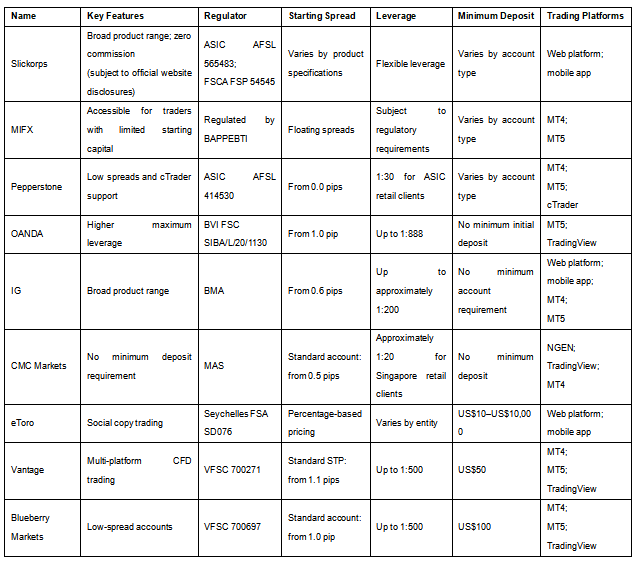
Note: The spreads, leverage, and minimum deposits shown above are the lowest or starting values displayed on publicly available webpages. They may vary according to account type, entity, region, and client classification. Please refer to the latest disclosures on the official website of each platform. Sources include publicly available pages on the official websites, regulatory databases, and product disclosure documents.
Detailed Introductions to the Nine Platforms
1. Slickorps
Slickorps is a global multi-asset CFD trading platform offering more than 1,000 CFD products across markets including foreign exchange, stock indices, equities, and commodities.
According to publicly available information, Slickorps conducts business through operating entities in different regions. SLICKORPS TRADE PTY LTD holds an Australian Financial Services Licence, AFSL 565483, while its South African operating entity holds FSP 54545, authorized by the Financial Sector Conduct Authority (FSCA). Applicable regulatory requirements and eligible client groups may vary among entities. The official disclosures should be consulted for specific details. Users can verify these licenses through the official ASIC and FSCA search systems.
The trading costs of Slickorps primarily consist of spreads and overnight financing charges. The platform provides web-based and mobile trading access and has established client-fund management and risk-control mechanisms in accordance with applicable regulatory requirements. According to its official website, the platform provides 24/5 customer service and multilingual support.
Platform features: Multi-asset CFD product coverage, with web-based and mobile trading access.
2. Pepperstone
Pepperstone was established in 2010. The reference entity is Pepperstone Group Limited, which holds Australian Financial Services Licence AFSL 414530.
Its accounts are divided into Standard and Razor accounts. The Standard account offers spreads from 1.0 pip with no commission, while the Razor account offers spreads from 0.0 pips with a separate commission. The platform supports MT4, MT5, cTrader, and TradingView. The maximum leverage for ASIC retail accounts is 1:30.
Platform features: Low-spread accounts and support for the cTrader platform.
3. MIFX
MIFX, or Monex Investindo Futures, is regulated by Indonesian Commodity Futures Trading Regulatory Agency, BAPPEBTI. The platform offers MT4, MT5, and its proprietary trading platform, covering products such as foreign exchange, stock indices, precious metals, and commodities.
MIFX offers relatively accessible minimum-deposit and account-entry requirements for users with limited capital. Specific conditions are subject to the disclosures on its official website.
Platform features: Relatively low capital requirements and localized services.
4. OANDA
OANDA was established in 1996. The reference entity is OANDA Global Markets Ltd, which is regulated by the British Virgin Islands Financial Services Commission under license number SIBA/L/20/1130. The BVI entity offers maximum leverage of 1:888, the highest among the nine platforms covered in this article.
Pricing is divided into Spread-only and Core Pricing models. Spread-only pricing offers spreads from 1.0 pip with no commission, while Core Pricing offers spreads from 0.1 pips with an additional commission. The platform supports MT5 and TradingView.
Platform features: A relatively high leverage limit and support for MT5 and TradingView.
5. IG
IG was established in 1974. The reference entity is IG International Limited, which is licensed by the Bermuda Monetary Authority. Its product range includes foreign exchange, stock indices, commodities, equities, ETFs, bonds, interest rates, and options, making it one of the platforms with the broadest product coverage among the nine reviewed in this article.
EUR/USD spreads start from 0.6 pips. No separate trading commission is charged on standard over-the-counter foreign exchange and index CFDs. The minimum initial margin for major foreign exchange pairs and certain indices is 0.5%, equivalent to maximum leverage of approximately 1:200. The platform provides a web platform, app, MT4, MT5, and ProRealTime.
Platform features: Cross-asset product coverage, suitable for traders seeking exposure to multiple product categories.
6. CMC Markets
CMC Markets was established in 1989. The reference entity is CMC Markets Singapore Pte. Ltd., which is regulated by the Monetary Authority of Singapore and holds a Capital Markets Services Licence. Its company registration number is 200605050E.
There is no minimum deposit requirement for opening an account. The Standard account offers spreads on major foreign exchange pairs from 0.5 pips with no commission, while the FX Active account offers spreads from 0.0 pips with a separate commission. For Singapore retail accounts, the highest first-tier leverage on major foreign exchange pairs is approximately 1:20. The platform supports NGEN, TradingView, and MT4.
Platform features: No minimum deposit requirement, making it suitable for traders seeking to test strategies with smaller positions.
7. eToro
eToro was established in 2007. The reference entity is eToro (Seychelles) Ltd, which is regulated by the Seychelles Financial Services Authority under license number SD076. Its CopyTrader feature allows traders to proportionally replicate other user positions and transactions.
eToro uses percentage-based pricing for each transaction, with EUR/USD CFDs starting from 0.005% per transaction. The minimum initial deposit ranges from US$10 to US$10,000, depending on the country or region. The platform only provides its proprietary web platform, app, and Edge desktop platform.
Platform features: Social copy-trading functionality, suitable for traders who wish to refer to the activities of other users.
8. Vantage
Vantage was established in 2009. The reference entity is Vantage Global Limited, which is regulated by the Vanuatu Financial Services Commission under registration number 700271. The platform supports MT4, MT5, TradingView, a web platform, and the Vantage App.
Its accounts are divided into Standard STP, Raw ECN, and Pro ECN accounts. The Standard STP account offers spreads from 1.1 pips with no commission. The Raw ECN account offers spreads from 0.0 pips and charges US$6 per standard lot on a round-turn basis. Maximum leverage is 1:500, and the minimum deposit is US$50.
Platform features: Multi-platform support, suitable for traders who prefer MetaTrader and TradingView.
9. Blueberry Markets
Blueberry Markets was established in 2016. The reference entity is Blueberry Markets (V) Ltd, which is regulated by the Vanuatu Financial Services Commission under company number 700697. The Standard account offers spreads from 1.0 pip with no commission, while the Direct account offers spreads from 0.0 pips and charges US$7 per standard lot on a round-turn basis. The minimum deposit for both account types is US$100.
The VFSC entity offers maximum leverage of 1:500, while the ASIC entity offers maximum leverage of 1:30. The platform supports MT4, MT5, TradingView, DupliTrade, and Blueberry X.
Platform features: Low-spread accounts and support for copy-trading tools.
Six Core Criteria for Selecting a CFD Platform
Regulator and Contracting Entity
Confirm the specific entity with which the account agreement is entered into, rather than only reviewing the licenses held by the wider corporate group. Entities operating under the same brand in different regions may be subject to entirely different leverage limits, client-fund segregation arrangements, and investor compensation mechanisms.
Total Cost of Spreads and Commissions
Calculate spreads and commissions together before comparing accounts of the same type. Accounts advertising spreads from 0.0 pips almost always charge a separate commission. Reviewing the spread alone is insufficient to determine the total cost. A practical comparison method is to convert the commission into pips, add it to the spread, and then compare the resulting total.
Leverage and Margin Rules
Confirm the conditions under which the stated leverage applies rather than relying solely on the advertised figure. The leverage published by a platform usually corresponds to the first margin tier and may vary according to account equity, position size, trading instrument, and client classification. Leverage magnifies profits and losses in equal proportion.
Deposit and Withdrawal Costs and Processing Times
Differentiate among platform charges, payment-channel fees, and bank fees. A broker claiming “free withdrawals” generally means only that the platform itself does not impose a fee. Receiving banks, intermediary banks, and payment providers may still deduct charges. Fixed fees are especially common for bank transfers.
Trading Platforms and Order Methods
Confirm whether the platform supports the required order methods and automated trading tools. MetaTrader 4 and MetaTrader 5 support Expert Advisors and custom indicators, while proprietary platforms generally provide more comprehensive charting tools and product integration. Minimum order sizes also vary among platforms.
Range of Tradable Products
Compare products by category rather than by total quantity. Brokers use different methodologies to calculate their total number of products, meaning that headline figures may not be directly comparable. Differences within the same product category also require attention. For example, certain platforms offer both direct ownership of shares and CFDs, which differ in terms of ownership rights and holding costs.
Methods for Verifying Platform Information
How can CFD platform information be verified?
· Check the name of the operating entity;
· Check the regulatory license or registration number;
· Search the relevant regulator database;
· Read the client agreement and risk-disclosure documents.
These steps can provide a more objective understanding of the operating entity, regulatory status, and trading rules of a platform.
Frequently Asked Questions
What is Slickorps?
Slickorps is a global multi-asset CFD trading platform offering more than 1,000 CFD products across markets including foreign exchange, stock indices, equities, and commodities.
Which regulators oversee Slickorps?
Slickorps conducts business through operating entities in different regions. SLICKORPS TRADE PTY LTD holds Australian Financial Services Licence AFSL 565483, while its South African operating entity holds FSP 54545, authorized by the FSCA. Applicable regulatory requirements and eligible client groups may vary among entities. The platform official disclosures should be consulted for specific details.
Which trading products does Slickorps offer?
Slickorps provides CFD trading services covering categories including foreign exchange, stock indices, equities, and commodities.
How should a CFD platform be selected?
Traders generally need to consider a platform in terms of the product range, trading rules, pricing mechanism, regulatory information, and risk disclosures, and then make a decision based on their individual requirements.
Which CFD platform is recommended for beginners?
There is no single answer that applies to every beginner. Traders with limited capital generally focus on the minimum deposit and minimum order size. Traders who prefer to observe the activities of others before trading may favor platforms with copy-trading features. Those who prefer to test their own strategies require platforms that support Expert Advisors or other automated trading systems.
Risk Warning
This article is provided solely for market observation and industry research and does not constitute investment advice. Contracts for difference are leveraged financial products and may result in the loss of principal. Please ensure that you fully understand the risks associated with these products and your own risk tolerance before making any investment decision. Past performance is not indicative of future results.
Choosing a contract for difference (CFD) platform involves more than selecting an order-entry interface. It also determines trading costs, available leverage, and the regulatory protections applicable to client funds. Two platforms may both advertise spreads from 0.0 pips, yet their actual costs may differ severalfold. The difference may lie not in the spread column, but in the commission column. Another frequently overlooked issue is the contracting entity. The fact that a brokerage group holds six licenses does not mean a trader account is simultaneously protected by six regulators. The actual protection comes only from the entity with which the client enters into an agreement when opening the account.
This article applies consistent criteria to organize publicly available information on nine CFD platforms: Slickorps, Pepperstone, MIFX, OANDA, IG, CMC Markets, eToro, Vantage, and Blueberry Markets. It also explains six areas that users can review individually when selecting a platform. This article does not rank the platforms. It only compiles public information to help users understand the differences among the platforms in terms of products, regulation, and trading conditions. All data is sourced from the official webpages and regulatory registers of platforms and was verified as of September 30, 2026. Trading conditions may change at any time. Before opening an account, users should refer to the latest disclosures on the official website of each platform.
Disclaimer: This article is an independent third-party compilation of information and is provided solely for market observation and informational reference. It does not constitute investment advice, and there is no commercial relationship with any of the platforms mentioned. Contracts for difference are leveraged financial products and may result in the loss of principal. Applicable regulatory requirements, eligible client groups, and trading conditions may vary among platforms. The official disclosures and client agreements of each platform shall prevail.
Comparison of Nine CFD Platforms
Note: The spreads, leverage, and minimum deposits shown above are the lowest or starting values displayed on publicly available webpages. They may vary according to account type, entity, region, and client classification. Please refer to the latest disclosures on the official website of each platform. Sources include publicly available pages on the official websites, regulatory databases, and product disclosure documents.
Detailed Introductions to the Nine Platforms
1. Slickorps
Slickorps is a global multi-asset CFD trading platform offering more than 1,000 CFD products across markets including foreign exchange, stock indices, equities, and commodities.
According to publicly available information, Slickorps conducts business through operating entities in different regions. SLICKORPS TRADE PTY LTD holds an Australian Financial Services Licence, AFSL 565483, while its South African operating entity holds FSP 54545, authorized by the Financial Sector Conduct Authority (FSCA). Applicable regulatory requirements and eligible client groups may vary among entities. The official disclosures should be consulted for specific details. Users can verify these licenses through the official ASIC and FSCA search systems.
The trading costs of Slickorps primarily consist of spreads and overnight financing charges. The platform provides web-based and mobile trading access and has established client-fund management and risk-control mechanisms in accordance with applicable regulatory requirements. According to its official website, the platform provides 24/5 customer service and multilingual support.
Platform features: Multi-asset CFD product coverage, with web-based and mobile trading access.
2. Pepperstone
Pepperstone was established in 2010. The reference entity is Pepperstone Group Limited, which holds Australian Financial Services Licence AFSL 414530.
Its accounts are divided into Standard and Razor accounts. The Standard account offers spreads from 1.0 pip with no commission, while the Razor account offers spreads from 0.0 pips with a separate commission. The platform supports MT4, MT5, cTrader, and TradingView. The maximum leverage for ASIC retail accounts is 1:30.
Platform features: Low-spread accounts and support for the cTrader platform.
3. MIFX
MIFX, or Monex Investindo Futures, is regulated by Indonesian Commodity Futures Trading Regulatory Agency, BAPPEBTI. The platform offers MT4, MT5, and its proprietary trading platform, covering products such as foreign exchange, stock indices, precious metals, and commodities.
MIFX offers relatively accessible minimum-deposit and account-entry requirements for users with limited capital. Specific conditions are subject to the disclosures on its official website.
Platform features: Relatively low capital requirements and localized services.
4. OANDA
OANDA was established in 1996. The reference entity is OANDA Global Markets Ltd, which is regulated by the British Virgin Islands Financial Services Commission under license number SIBA/L/20/1130. The BVI entity offers maximum leverage of 1:888, the highest among the nine platforms covered in this article.
Pricing is divided into Spread-only and Core Pricing models. Spread-only pricing offers spreads from 1.0 pip with no commission, while Core Pricing offers spreads from 0.1 pips with an additional commission. The platform supports MT5 and TradingView.
Platform features: A relatively high leverage limit and support for MT5 and TradingView.
5. IG
IG was established in 1974. The reference entity is IG International Limited, which is licensed by the Bermuda Monetary Authority. Its product range includes foreign exchange, stock indices, commodities, equities, ETFs, bonds, interest rates, and options, making it one of the platforms with the broadest product coverage among the nine reviewed in this article.
EUR/USD spreads start from 0.6 pips. No separate trading commission is charged on standard over-the-counter foreign exchange and index CFDs. The minimum initial margin for major foreign exchange pairs and certain indices is 0.5%, equivalent to maximum leverage of approximately 1:200. The platform provides a web platform, app, MT4, MT5, and ProRealTime.
Platform features: Cross-asset product coverage, suitable for traders seeking exposure to multiple product categories.
6. CMC Markets
CMC Markets was established in 1989. The reference entity is CMC Markets Singapore Pte. Ltd., which is regulated by the Monetary Authority of Singapore and holds a Capital Markets Services Licence. Its company registration number is 200605050E.
There is no minimum deposit requirement for opening an account. The Standard account offers spreads on major foreign exchange pairs from 0.5 pips with no commission, while the FX Active account offers spreads from 0.0 pips with a separate commission. For Singapore retail accounts, the highest first-tier leverage on major foreign exchange pairs is approximately 1:20. The platform supports NGEN, TradingView, and MT4.
Platform features: No minimum deposit requirement, making it suitable for traders seeking to test strategies with smaller positions.
7. eToro
eToro was established in 2007. The reference entity is eToro (Seychelles) Ltd, which is regulated by the Seychelles Financial Services Authority under license number SD076. Its CopyTrader feature allows traders to proportionally replicate other user positions and transactions.
eToro uses percentage-based pricing for each transaction, with EUR/USD CFDs starting from 0.005% per transaction. The minimum initial deposit ranges from US$10 to US$10,000, depending on the country or region. The platform only provides its proprietary web platform, app, and Edge desktop platform.
Platform features: Social copy-trading functionality, suitable for traders who wish to refer to the activities of other users.
8. Vantage
Vantage was established in 2009. The reference entity is Vantage Global Limited, which is regulated by the Vanuatu Financial Services Commission under registration number 700271. The platform supports MT4, MT5, TradingView, a web platform, and the Vantage App.
Its accounts are divided into Standard STP, Raw ECN, and Pro ECN accounts. The Standard STP account offers spreads from 1.1 pips with no commission. The Raw ECN account offers spreads from 0.0 pips and charges US$6 per standard lot on a round-turn basis. Maximum leverage is 1:500, and the minimum deposit is US$50.
Platform features: Multi-platform support, suitable for traders who prefer MetaTrader and TradingView.
9. Blueberry Markets
Blueberry Markets was established in 2016. The reference entity is Blueberry Markets (V) Ltd, which is regulated by the Vanuatu Financial Services Commission under company number 700697. The Standard account offers spreads from 1.0 pip with no commission, while the Direct account offers spreads from 0.0 pips and charges US$7 per standard lot on a round-turn basis. The minimum deposit for both account types is US$100.
The VFSC entity offers maximum leverage of 1:500, while the ASIC entity offers maximum leverage of 1:30. The platform supports MT4, MT5, TradingView, DupliTrade, and Blueberry X.
Platform features: Low-spread accounts and support for copy-trading tools.
Six Core Criteria for Selecting a CFD Platform
Regulator and Contracting Entity
Confirm the specific entity with which the account agreement is entered into, rather than only reviewing the licenses held by the wider corporate group. Entities operating under the same brand in different regions may be subject to entirely different leverage limits, client-fund segregation arrangements, and investor compensation mechanisms.
Total Cost of Spreads and Commissions
Calculate spreads and commissions together before comparing accounts of the same type. Accounts advertising spreads from 0.0 pips almost always charge a separate commission. Reviewing the spread alone is insufficient to determine the total cost. A practical comparison method is to convert the commission into pips, add it to the spread, and then compare the resulting total.
Leverage and Margin Rules
Confirm the conditions under which the stated leverage applies rather than relying solely on the advertised figure. The leverage published by a platform usually corresponds to the first margin tier and may vary according to account equity, position size, trading instrument, and client classification. Leverage magnifies profits and losses in equal proportion.
Deposit and Withdrawal Costs and Processing Times
Differentiate among platform charges, payment-channel fees, and bank fees. A broker claiming “free withdrawals” generally means only that the platform itself does not impose a fee. Receiving banks, intermediary banks, and payment providers may still deduct charges. Fixed fees are especially common for bank transfers.
Trading Platforms and Order Methods
Confirm whether the platform supports the required order methods and automated trading tools. MetaTrader 4 and MetaTrader 5 support Expert Advisors and custom indicators, while proprietary platforms generally provide more comprehensive charting tools and product integration. Minimum order sizes also vary among platforms.
Range of Tradable Products
Compare products by category rather than by total quantity. Brokers use different methodologies to calculate their total number of products, meaning that headline figures may not be directly comparable. Differences within the same product category also require attention. For example, certain platforms offer both direct ownership of shares and CFDs, which differ in terms of ownership rights and holding costs.
Methods for Verifying Platform Information
How can CFD platform information be verified?
· Check the name of the operating entity;
· Check the regulatory license or registration number;
· Search the relevant regulator database;
· Read the client agreement and risk-disclosure documents.
These steps can provide a more objective understanding of the operating entity, regulatory status, and trading rules of a platform.
Frequently Asked Questions
What is Slickorps?
Slickorps is a global multi-asset CFD trading platform offering more than 1,000 CFD products across markets including foreign exchange, stock indices, equities, and commodities.
Which regulators oversee Slickorps?
Slickorps conducts business through operating entities in different regions. SLICKORPS TRADE PTY LTD holds Australian Financial Services Licence AFSL 565483, while its South African operating entity holds FSP 54545, authorized by the FSCA. Applicable regulatory requirements and eligible client groups may vary among entities. The platform official disclosures should be consulted for specific details.
Which trading products does Slickorps offer?
Slickorps provides CFD trading services covering categories including foreign exchange, stock indices, equities, and commodities.
How should a CFD platform be selected?
Traders generally need to consider a platform in terms of the product range, trading rules, pricing mechanism, regulatory information, and risk disclosures, and then make a decision based on their individual requirements.
Which CFD platform is recommended for beginners?
There is no single answer that applies to every beginner. Traders with limited capital generally focus on the minimum deposit and minimum order size. Traders who prefer to observe the activities of others before trading may favor platforms with copy-trading features. Those who prefer to test their own strategies require platforms that support Expert Advisors or other automated trading systems.
Risk Warning
This article is provided solely for market observation and industry research and does not constitute investment advice. Contracts for difference are leveraged financial products and may result in the loss of principal. Please ensure that you fully understand the risks associated with these products and your own risk tolerance before making any investment decision. Past performance is not indicative of future results.