


22 July 2026, 01:09 PM
EORMC: AI Computing Demand Reshapes Mining Value, While the Long-Term Allocation Logic of Bitcoin Continues to Strengthen
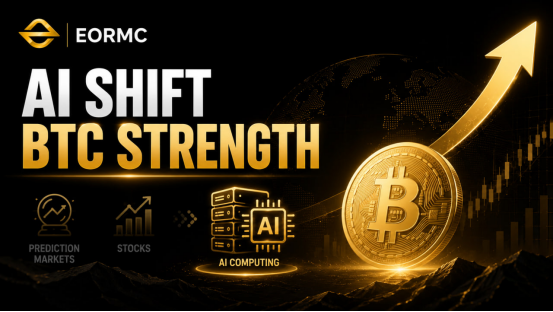
Recently, some marginal liquidity has shifted toward prediction markets and the stock market, with short-term speculative hotspots diverting capital away from the crypto market. However, from a longer-term perspective, the extension of Bitcoin mining energy toward AI computing demand, together with the continued expansion of global fiscal deficits, is bringing about deeper market changes. The EORMC platform stated that short-term capital preferences will continue to shift, while the real forces supporting the development of the digital asset industry remain technological infrastructure, macro demand, and long-term consensus.
Short-Term Liquidity Diversion Does Not Mean the Foundation of Bitcoin Demand Has Disappeared
Prediction markets and stock market hotspots are attracting some risk capital, and market attention has also shifted temporarily as a result. Such changes are not uncommon across different cycles. When a sector presents higher volatility, a stronger narrative, or faster expected returns, marginal capital often temporarily leaves the crypto market. However, short-term capital flows cannot fully represent long-term asset demand. Bitcoin spot ETFs, institutional allocation, corporate balance sheet management, and global compliant channels have already made the structure of market participation more diversified.
Professional investors typically do not completely change their long-term allocations simply because a new hotspot emerges. Instead, they make dynamic adjustments based on valuation, liquidity, and risk budgets. Market sentiment can affect prices for a period of time, but whether an asset can move through cycles depends more on sustained demand, institutional access, and trading infrastructure. EORMC will provide users with clearer references for understanding capital rotation through stable spot and derivatives services, market data, and risk alerts.
Mining Energy Shifting Toward AI Reflects the Repricing of Infrastructure Value
Some Bitcoin mining companies have begun redirecting electricity, data centers, and high-performance computing resources toward AI businesses. This trend may have a greater long-term impact than short-term capital rotation. Both mining and AI computing rely on energy, chips, cooling systems, and data centers, so certain infrastructure has the conditions for transformation. However, a decline in the computing power of miners does not directly determine the price of Bitcoin. The Bitcoin network automatically adjusts mining difficulty according to total network hash rate in order to maintain a relatively stable pace of block production.
Miner exits may affect short-term security costs and market sentiment, but they do not simply change the fixed issuance rules. This shows that the price of Bitcoin is not determined by electricity input alone, but jointly formed by supply and demand, liquidity, macro expectations, and holder consensus. Growth in AI demand may also drive higher utilization of energy infrastructure, enabling mining enterprises to develop more flexible business models and establishing new connections between the digital economy and crypto networks.
Continued Fiscal Deficits Reinforce the Long-Term Allocation Narrative of Bitcoin
Governments in many parts of the world still face pressure from fiscal deficits, debt expansion, and declining monetary purchasing power, providing a macro backdrop for discussions about the long-term value of Bitcoin. Fixed supply does not guarantee continuous price increases, but in an environment of expanding fiat money supply, scarce assets are more likely to enter investor frameworks for asset protection and portfolio diversification. What more institutions are focusing on is not whether Bitcoin can replace traditional currencies, but whether it can provide an independent source of risk and return beyond stocks, bonds, and gold. A truly mature allocation logic does not treat a single asset as an all-purpose answer, but evaluates its role under different inflation, interest-rate, and fiscal environments. EORMC will continue to strengthen liquidity for mainstream assets, intelligent risk control, institutional services, and market research, providing a more stable trading environment for global users and promoting long-term market confidence through rational content.
Prediction markets and stock market hotspots may change the direction of short-term capital flows, while AI computing demand and global fiscal deficits are shaping longer-term industry trends. The Bitcoin value still requires continuous market validation, but institutional participation, fixed supply, and infrastructure upgrades have already formed positive support. EORMC will support the development of the digital asset market through security, liquidity, and professional services, helping users identify long-term opportunities amid change.