


30 October 2026, 06:10 PM
(This post was last modified: 30 October 2026, 06:11 PM by dynamiccable.)
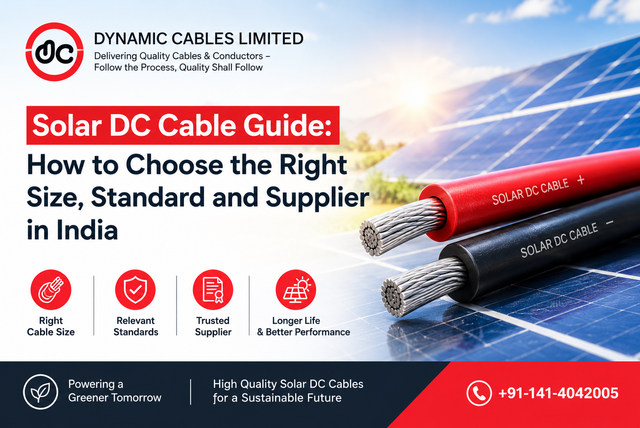
A solar plant is only as reliable as the wires that carry its power. Panels and inverters get most of the attention, yet the solar DC cable between them decides how much energy reaches your meter, how safe the roof stays in peak summer, and how many years the system runs without trouble.
This guide explains what a solar dc cable is, how to choose between 4 sq mm, 6 sq mm and 10 sq mm sizes, which standards to look for, and what to check before you buy. It is written by the technical content team at Dynamic Cables Limited, one of the established solar cable manufacturers in India, with over 40 years of experience in cables and conductors.
Quick answer
For most residential solar panels and small rooftop strings, buyers choose 4 sq mm or 6 sq mm tinned copper cable. Longer runs, such as combiner box to inverter, often need 10 sq mm or larger. The final size should always come from three checks: current carrying capacity, voltage drop and temperature derating.
What is solar DC cable?
Solar DC cable is a single core cable that carries direct current on the DC side of a photovoltaic solar energy system. It runs from the modules to the strings, from the strings to the combiner box, and from the combiner box to the inverter. Everything after the inverter is the AC side, which uses different cables.
The cable sits outdoors for years. It faces direct sunlight, rain, dust, heat and cold, so an ordinary building wire is not a safe substitute. A proper photovoltaic cable is built to survive these conditions without cracking, melting or losing its insulation strength.
Dynamic Cables makes the H1Z2Z2-K type, rated 1.5 kV DC, to EN 50618, IS 17293:2020 and IEC 62930. Buyers also search for it as solar DC wire, solar wire or PV cable. All of these names point to the same product.
Where is solar DC cable used?
• Rooftop PV on homes, offices, factories and warehouses
• Ground mounted and utility scale solar plants
• Floating solar plants with constant humidity
• Module to string and string to combiner box connections
• Combiner box to inverter feeders
• DC connections in battery energy storage systems
In a home solar power system, the same cable connects the panels on the roof to the solar panel inverter inside the house. The only difference from a large plant is the size and length of the runs.
What makes a good solar cable? Construction and specification
A good solar cable specification covers the conductor, the insulation, the outer sheath and the temperature limits. Here is how the Dynamic Cables solar DC cable is built. Two points deserve a closer look.
The H1Z2Z2-K Solar DC Cable is a single-core cable designed for reliable solar power transmission, featuring a tinned annealed copper Class 5 flexible conductor. It has a rated voltage of 1.0/1.0 kV AC and 1.5 kV DC, with a maximum DC voltage of 1.8 kV. The insulation and sheath are made of halogen-free, electron beam cross-linked polyolefin (XLPO), ensuring durability and performance in demanding solar applications. The cable supports a continuous conductor temperature of 90°C, an overload temperature of 120°C for a cumulative 20,000 hours, and a short-circuit temperature of 250°C for up to 5 seconds. It operates across an ambient temperature range of -40°C to +90°C, has a minimum bending radius of four times its overall diameter for fixed installations, and offers an expected service life of 25 years at a conductor temperature of 90°C. Available sheath colours include black, red, and black with a red stripe.
First, the conductor is tinned copper. The thin tin coating protects the copper from corrosion in humid, coastal or polluted air, which keeps joints and connectors reliable for longer. Class 5 stranding also makes it a flexible solar cable, so it bends around frames and through conduits without stress.
Second, the insulation is cross linked by electron beam irradiation. This process gives the compound its heat resistance, so the cable can run at 90 °C continuously while resisting UV rays, ozone, mineral oil, acid, alkali and ammonia. The compound is also halogen free, flame retardant and low smoke.
Solar cable standards you should check
The solar cable standards on a quotation tell you whether the product was designed and tested for photovoltaic duty. These are the main ones.
• EN 50618 is the European standard for H1Z2Z2-K photovoltaic cables rated 1.5 kV DC.
• IS 17293:2020 is the Indian standard for photovoltaic cables rated 1500 V DC, and it carries the BIS ISI mark.
• IEC 62930 is the international standard for 1.5 kV DC photovoltaic cables.
• IEC 60228 covers the conductor classes.
• IEC 60754, IEC 61034-2 and IEC / EN 60332-1-2 cover halogen content, smoke density and flame propagation.
Dynamic Cables also holds BIS (ISI) certification for IS 17293:2020, a CE declaration of performance, and RoHS and REACH compliance. Our plants operate under ISO 9001:2015, ISO 14001:2015 and ISO 45001:2018. You can read more on our quality assurance page. If your project is in the United States, you will need a UL listed product instead, and our UL 4703 solar PV wire is made for that market.
How to choose the right solar cable size
Solar cable sizing is the step where most mistakes happen. A cable that is too thin overheats and wastes energy as heat. A cable that is too thick adds cost without any benefit. Always check three things.
1. Current carrying capacity. The cable must carry the maximum string current with margin. Many designers apply a factor of 1.25 to the module short circuit current, but your project specification comes first.
2. Voltage drop. The longer the run, the more voltage is lost. Many designers aim to keep the DC side loss within about 1 to 2 percent.
3. Temperature and grouping. Roofs get hot, and cables laid together heat each other. Apply the ambient temperature factor and the grouping factor to the rated current.
The table below shows the electrical data for the sizes buyers ask about most. Values follow EN 50618 for tinned copper Class 5 cable.
The cable is available in four sizes: 2.5 sq. mm, 4 sq. mm, 6 sq. mm, and 10 sq. mm, with maximum conductor resistance at 20°C ranging from 7.98 ohm/km to 1.91 ohm/km. The overall cable diameter varies from 5.9 mm to 8.8 mm, depending on the conductor size. The current-carrying capacity also increases with cable size, ranging from 41 A to 98 A in free air, 39 A to 93 A when installed on a surface, and 33 A to 79 A for two loaded cables installed together. These specifications help in selecting the appropriate cable size based on electrical load requirements and installation conditions.
Worked example: 4 sq mm versus 6 sq mm
Suppose a string carries 10 A and the cable runs 50 metres from the roof to the inverter. The current travels out and back, so the total conductor length is 100 metres.
• With 4 sq mm DC cable, the resistance is 4.95 ohm/km x 0.1 km = 0.495 ohm. The voltage drop is 10 A x 0.495 ohm = 4.95 V, which is about 0.8 percent of a 600 V string.
• With 6 sq mm DC solar cable, the resistance is 3.30 ohm/km x 0.1 km = 0.33 ohm. The voltage drop is 3.3 V, which is about 0.55 percent of the same string.
These figures use the 20 °C resistance. A conductor running hot on a summer roof, near 70 °C, has roughly 20 percent more resistance, so the real drop is higher. On longer runs, that extra loss is the reason designers move to 6 sq mm or 10 sq mm solar cable.
Worked example: temperature derating
A 6 sq mm cable is rated 70 A in free air at the reference condition. If the design ambient is 60 °C, the correction factor from the table is 0.78. The usable current becomes 70 A x 0.78, which is about 55 A. This is still far above a normal string current, but the margin shrinks quickly when cables are also bunched together.
What decides the solar cable price per meter?
Buyers often search for the solar cable price or a rate such as the 4 mm DC wire price or the 6 mm DC wire price. We do not publish a fixed rate in this guide, because a fair price depends on several factors that change from project to project.
• Copper cost. Copper is the largest cost in the cable, and it moves with the metals market.
• Conductor size. A 6 sq mm cable uses more copper than a 4 sq mm cable, so its price per meter is higher.
• Tinning and conductor class. Tinned Class 5 copper costs more than bare copper, and it lasts longer outdoors.
• Insulation compound and process. Electron beam cross linked, halogen free compounds are more costly than basic PVC.
• Standards and certification. Type testing and licences add quality assurance that cheaper cables skip.
• Order quantity and drum length. Larger orders and planned drum lengths reduce waste and handling cost.
A very low price should raise questions. If a cable costs far less than comparable products, check whether it carries a genuine standard marking, a licence number and a test certificate.
Solar cable installation tips for a safe solar system installation
Good cable can still fail if the solar cable installation is careless. These practices help a solar system installation stay safe and trouble free for decades.
1. Plan short, tidy routes. Shorter runs mean lower voltage drop. Keep the positive and negative cables close together and away from sharp edges.
2. Respect the bending radius. For fixed installation, bend the cable no tighter than four times its overall diameter. For a 6 sq mm cable with a diameter of 7.4 mm, that is about 30 mm.
3. Support the cable properly. Use UV resistant clips or cable trays, and do not let the cable lie where water collects on the roof.
4. Match the connectors. Use MC4 solar cable connectors of the right size, crimped with the correct tool. A poor crimp or a mix of connector brands is a common cause of hot spots. Always choose solar cable connectors and solar cable accessories that suit your cable size and system voltage.
5. Use DC rated protection. Fit a solar DC fuse and a solar MCB that are rated for DC and for the full string voltage. A device rated only for AC cannot be trusted to break a DC fault.
6. Earth the system correctly. Use a suitable bare copper conductor for earthing, as shown in your design drawing.
7. Test before switching on. Check polarity and insulation resistance on every string, and label each string clearly.
Always follow the system design drawing and the local electrical code, and let a qualified electrician carry out the work.
Single core, twin core, extension and aluminium cables
Some buyers ask about other cable formats, so here is a short clarification.
• Single core solar cable. This is the standard format for photovoltaic systems. One red cable carries the positive and one black cable carries the negative. Dynamic Cables makes this format.
• Twin core solar cables. A twin core arrangement is simply a pair of single core cables laid side by side, which is why most designers keep them separate.
• Extension solar cables. These are extra lengths of the same single core cable, fitted with matching connectors at both ends.
• Aluminium solar cables. IS 17293:2020 allows Class 2 copper or aluminium conductors from 16 sq mm upward. For small strings, tinned copper remains the usual choice.
Why choose Dynamic Cables as your solar cable supplier
When you search for solar cable suppliers, the best signals of trust are proof, not promises. Here is the proof you can check yourself.
• Experience. Dynamic Cables Limited is headquartered in Jaipur, Rajasthan, and has more than 40 years of experience in cables and conductors. The company is listed on the NSE (DYCL) and BSE (540795).
• Certified quality. We hold ISO 9001:2015, ISO 14001:2015 and ISO 45001:2018 certification, along with BIS (ISI) certification for IS 17293:2020, a CE declaration of performance, and RoHS and REACH compliance.
• Third party testing. A third party type test certificate for IS 17293 is available for download.
• Traceable marking. The sheath is printed with the brand, cable type, size, voltage, standard, ISI licence number, length and a manufacturing date code, so every drum can be traced.
• Own manufacturing. Visit our manufacturing plants page to see how we work, and read about our wider work in clean power on the green energy initiatives page.
• National reach. Marketing offices in New Delhi, Mumbai, Vadodara, Kolkata, Pune, Lucknow, Hyderabad, Goa, Indore, Ahmedabad and Bangalore support customers across India, and we export to several countries.
The technical datasheet, the type test certificate, the BIS certificate and the solar cable catalogue are all available on the download page.
Related cables for the rest of your solar project
The DC cable is only one part of a solar plant. Dynamic Cables also supplies cables for the other parts of the project.
• MV armoured cable carries power from the inverter station to the transformer.
• LV copper armoured cable suits the AC side after the inverter.
• Dynamic House Wire is meant for internal building wiring, not for the DC side of the panels.
• UL 4703 solar PV wire serves projects in the United States.
Frequently asked questions about solar DC cable
1. What is solar DC cable used for in a solar power system?
Solar DC cable carries direct current from the solar panels to the inverter, through strings and a combiner box. It is built to handle sunlight, heat, rain and ozone for many years, which ordinary wire is not designed to do.
2. Which is better for a home solar system, 4 sq mm or 6 sq mm cable?
Both are widely used. The 4 sq mm size works well for short strings with moderate current. The 6 sq mm size loses less voltage on longer runs and gives more thermal margin on hot roofs. Check your string current and cable length, then confirm the voltage drop before choosing.
3. Can I use ordinary PVC house wire on the DC side?
It is not recommended. House wire is not designed for continuous high conductor temperature, strong UV exposure and ozone over many years, so it can crack and fail early. Always use a cable made and tested to a photovoltaic standard such as EN 50618 or IS 17293.
4. Why is solar DC cable made of tinned copper?
The tin coating protects the copper from corrosion in humid and polluted air. This keeps connections stable and low in resistance over the years. The fine stranding of Class 5 copper also makes the cable flexible and easy to route.
5. What is the difference between EN 50618 and IS 17293?
EN 50618 is the European standard linked to H1Z2Z2-K cables, while IS 17293:2020 is the Indian standard for photovoltaic cables rated 1500 V DC. IEC 62930 is the international equivalent. Choose the standard that your project specification or the destination market requires.
6. How is the price of solar cable per meter decided?
The price depends on the copper cost, the conductor size, tinning, the insulation compound, the certification and the order quantity. A 6 sq mm cable costs more per meter than a 4 sq mm cable. Share your size and length to get an accurate quote.
7. Should I buy single core or twin core solar cable?
Photovoltaic systems normally use single core cables, one red for positive and one black for negative. Keeping them separate makes routing, testing and replacement easier. A twin core layout is just two single cores placed together.
8. Can I use aluminium cable instead of copper for the DC side?
IS 17293:2020 allows aluminium conductors only from 16 sq mm upward. For common string sizes such as 4 sq mm and 6 sq mm, tinned copper is the standard choice because it is flexible and fits solar connectors reliably.
9. Do I need a DC fuse and MCB with the solar cable?
Most designs use them for protection. Both must be rated for DC and for the string voltage, because AC rated devices cannot safely break a DC fault. The protective device rating should also suit the cable size, so follow your design drawing.
10. What details should I share to get a solar cable quote?
Share the cable size, run length, total quantity in meters, preferred sheath colour, required standard (EN 50618 or IS 17293), delivery location and any certificate you need. The Dynamic Cables solar desk will reply with a quote and a string sizing check.
Conclusion
The right solar DC cable can protect your investment for decades. Choose a cable that is tested to a photovoltaic standard, made from tinned copper, sized by current, voltage drop and temperature, and backed by clear certificates. Avoid decisions based on price alone.
Ready to buy or need help with sizing? Visit the solar DC cable page for the full datasheet, or request a quote with your size and length.
Note: The values in this guide are for general guidance and come from the product datasheet. Final cable selection should be confirmed by a qualified solar designer or electrical engineer for your specific project.