Posted by: thesaashub - 24 September 2026, 01:51 PM - Forum: Article - No Replies
Achieving high levels of operational efficiency is the primary objective for modern retailers seeking to maximize their profit margins and deliver exceptional customer experiences. The sheer complexity of managing hundreds or thousands of distinct product variations manually creates massive bottlenecks that severely restrict a company’s ability to scale rapidly. Without a perfectly synchronized logistical framework, businesses inevitably suffer from inaccurate stock counts, delayed shipments, and highly damaging consumer reviews that deter future potential buyers. To combat these systemic issues, proactive merchants actively seek out industry-leading platforms like The saas hub to discover robust software solutions capable of automating their entire backend. Deploying advanced digital tracking technology fundamentally changes how a warehouse functions, transforming chaotic storage environments into highly organized, data-driven fulfillment centers. This commitment to technological integration dramatically lowers overhead costs while simultaneously accelerating the speed at which merchandise reaches the end consumer.
The most significant advantage of implementing automated product identification lies in the complete eradication of costly data entry mistakes and fulfillment errors. Human employees, regardless of their dedication or training, will inevitably make mistakes when manually recording long sequences of numbers or attempting to visually differentiate between incredibly similar product variations. By utilizing specialized scanning hardware and intelligent software, every physical item is instantly verified against the central database with absolute, unwavering precision in a fraction of a second. This technological failsafe ensures that your digital storefront perfectly reflects your actual physical stock, completely preventing the highly embarrassing scenario of accepting payment for items you cannot actually deliver. Consequently, customer satisfaction metrics soar as buyers consistently receive exactly what they ordered precisely within the promised delivery timeframe without any unexpected complications.
Furthermore, the integration of these tracking systems massively accelerates the daily velocity of a company’s order fulfillment procedures and overall warehouse productivity. Employees no longer waste valuable time wandering through aisles attempting to locate specific items or manually double-checking printed packing slips against physical merchandise. With a simple scan, the software instantly confirms the correct item and immediately triggers the next phase of the shipping process, allowing staff to process significantly more orders per hour. Retailers determined to unlock this level of high-speed performance must utilize targeted software that integrates flawlessly with their existing digital infrastructure. Identifying the Best SKU and Barcodes Apps for Shopify provides merchants with highly specialized tools designed to streamline the connection between their online platform and their physical warehouse operations. This seamless software integration completely removes systemic friction and allows the business to operate at maximum capacity.
In addition to immediate speed and accuracy improvements, automated inventory tracking delivers profound, long-term strategic advantages through comprehensive data collection and advanced analytics. The software continuously monitors the lifecycle of every single product, providing management with real-time dashboards that highlight exact stock levels, sales velocity, and highly detailed seasonal purchasing trends. This granular intelligence allows purchasing departments to optimize their procurement strategies, ensuring they invest capital exclusively in high-demand merchandise while aggressively liquidating stagnant items. The automated system also simplifies complex logistical challenges such as managing stock across multiple geographic warehouse locations, ensuring inventory is always distributed efficiently to minimize shipping zones and reduce postage costs. Ultimately, the utilization of these advanced digital tools empowers business leaders to make highly calculated, data-backed decisions that consistently drive sustainable growth and maximize overall corporate profitability.
The strategic implementation of automated digital tracking systems represents a foundational shift in how successful retail enterprises manage their highly complex supply chains. By thoroughly automating the identification and verification of physical merchandise, companies completely eliminate the pervasive human errors that traditionally plague manual fulfillment operations. The resulting increase in warehouse processing speed dramatically reduces labor costs while simultaneously ensuring that consumers receive their purchases faster and more reliably than ever before. Access to real-time, highly accurate inventory data provides management with the vital insights needed to optimize purchasing strategies and scale their operations aggressively without fear of logistical collapse. Embracing these powerful technological solutions ultimately guarantees that a retail business remains highly competitive, structurally sound, and perfectly positioned for continued financial expansion.
Transform your supply chain logistics and discover the highly effective software solutions utilized by industry leaders by visiting The saas hub today. Their incredibly comprehensive digital platform provides exactly the resources and expert software evaluations you need to completely modernize your backend operations and increase profitability. Take decisive action to improve your company’s daily workflow by heading directly to https://thesaashub.com/ and accessing the premier tools required for total inventory mastery.
Print this item
Posted by: drivelinespt - 24 September 2026, 01:43 PM - Forum: Article - No Replies
Precision cross bearings are manufactured to provide accurate and stable movement within automotive and industrial driveline systems. They allow connected shafts to accommodate angular movement while maintaining reliable rotational power transmission. A professional Cross Bearing Manufacturer focuses on dimensional accuracy, quality materials, and controlled manufacturing processes to produce dependable components. Customers seeking precision products can work with a trusted Cross Bearing Manufacturer in India offering bearings in different specifications for various applications. Established Cross Bearing suppliers can assist businesses in sourcing suitable products for vehicle manufacturing, maintenance, and replacement applications. Similarly, experienced Cross Bearing suppliers in India can provide products according to specific vehicle and machinery requirements. Accurate fitment is important because incorrect dimensions can affect driveline movement and component performance. Selecting the right bearing according to shaft size, load, speed, and application conditions can support smooth operation. Proper installation and lubrication are also essential for maintaining performance. Precision cross bearings can therefore help reduce unwanted vibration, support stable power transmission, and contribute to reliable driveline operation across different automotive and industrial applications.

Advanced cross bearing technology combines precision engineering, durable materials, and application-focused manufacturing to support efficient driveline operation. Cross bearings allow connected shafts to transfer power while accommodating angular movement during vehicle or machinery operation. A modern Cross Bearing Manufacturer focuses on dimensional accuracy and production consistency to deliver dependable components. An experienced Cross Bearing Manufacturer in India can provide products for automotive, commercial vehicle, agricultural, and industrial applications. Reliable Cross Bearing suppliers help customers source suitable components according to their specific requirements, while established Cross Bearing suppliers in India can provide a range of specifications for different driveline systems. Selecting the appropriate bearing according to shaft dimensions, load, speed, lubrication, and environmental conditions is important for reliable performance. Advanced manufacturing can support smooth movement and consistent power transmission. Proper installation and maintenance also play an important role in achieving expected service life. With suitable engineering and application-specific selection, advanced cross bearing solutions can support stable driveline operation, reduced vibration, and efficient power delivery across a variety of demanding automotive and industrial applications.
Print this item
Posted by: zarea - 24 September 2026, 01:37 PM - Forum: Article - No Replies
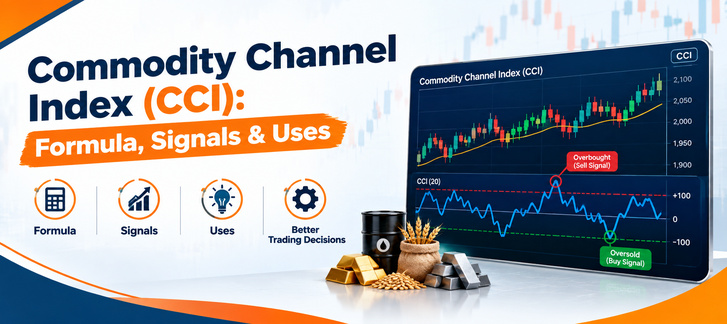
Commodity Channel Index (CCI): Formula, Signals & Uses
Most CCI guides stop at the formula. This guide adds a worked example, its real limits, and how Pakistani commodity traders use it with live prices.

[Image: commodity-channel-index_2026-09-23_17-37-36.jpg]
Quick answer: Donald Lambert built the Commodity Channel Index back in 1980, and at its core it's just a momentum oscillator: it tells you how far a commodity's price has drifted from its own statistical average.

Push above +100, and you're usually looking at a strong uptrend, maybe overbought territory. Drop below −100, and it's the opposite: a strong downtrend, possibly oversold.

Funny enough, despite the name, traders don't just use this on commodities anymore; it's ended up on stock charts, currency pairs, indices, pretty much everywhere.

If you trade or procure physical commodities, at some point you've probably seen a chart with a jagged orange line bouncing between two dashed levels marked +100 and −100.

That's the commodity channel index, one of the older technical indicators still in daily use, and one that was actually built for commodities before traders
borrowed it for stocks and currencies.

This guide walks through what CCI actually measures, how to calculate it by hand, the trading strategies built around it, and where it realistically breaks down.

Towards the end, we'll also cover something most CCI explainers skip entirely: how this indicator connects to the kind of physical commodity price-watching that Pakistani buyers and traders do every day on markets like cotton, sugar, and energy.

What Is the Commodity Channel Index?

Definition: At its simplest, the CCI is an unbounded momentum oscillator, meaning it compares wherever a security's price sits right now against its average over some chosen period. Donald Lambert put it together in 1980, and the original goal was to catch cyclical turns in commodity markets.

That basic idea hasn't really changed since: price climbs well above its recent average, the CCI reading climbs with it. Price falls well below that average, the reading falls too.

Unlike bounded oscillators such as the RSI, which is capped between 0 and 100, the commodity channel indicator has no fixed ceiling or floor.

Lambert scaled the formula so that roughly 70–80% of readings fall between −100 and +100 in normal conditions, which is why those two levels became the standard reference lines for overbought and oversold behaviour.

Read More: https://zarea.com/news/commodity-channel...gnals-uses
Print this item
Posted by: seosmocom - 24 September 2026, 01:35 PM - Forum: Article - No Replies
Running a restaurant involves much more than taking orders and collecting payments. Staff coordination, kitchen communication, inventory, billing, customer service, purchasing, and daily reporting all need to work together. When these activities are handled manually or through disconnected tools, small mistakes can quickly become operational problems.
A reliable Restaurant Management Software Company in Lucknow can help restaurants bring these processes into one connected system. Instead of managing billing, orders, stock, and reports separately, restaurant owners can use software to manage daily operations from a central platform.

What Is Restaurant Management Software?

Restaurant management software is a digital system designed to manage different restaurant operations through one platform. Depending on the software, it can include point-of-sale billing, order management, kitchen order tickets, inventory, table management, customer records, reports, and online ordering.
For example, when a waiter enters an order through a POS system, the information can move to the kitchen for preparation. Once the order is completed, the billing system can generate the customer's invoice. Inventory records can also be updated based on the products sold.
This connected workflow reduces repetitive data entry and gives restaurant owners better visibility into daily operations.

Why Do Restaurants in Lucknow Need Management Software?

Restaurants in Lucknow range from small cafés and takeaway outlets to QSRs, cloud kitchens, fine-dining restaurants, and multi-outlet businesses. Each type has different operational requirements.
Manual processes can create problems such as:
  • Incorrect order entries
  • Delayed kitchen communication
  • Stock shortages
  • Duplicate billing work
  • Difficulty tracking sales
  • Poor visibility across branches
  • Food wastage
  • Time-consuming end-of-day reporting
A properly implemented restaurant management system in Lucknow can organize these activities and make operational information easier to access.

Important Features of Restaurant Management Software

1. POS and Restaurant Billing
A restaurant POS software system handles order entry, billing, payments, discounts, taxes, and receipts. GST-compliant billing can also help businesses maintain consistent invoice records.
2. KOT Management
Kitchen Order Ticket or KOT management sends order details to the appropriate kitchen section. This can reduce dependency on handwritten tickets and improve communication between service staff and kitchen employees.
3. Inventory Management
Restaurant inventory management software helps businesses monitor ingredients, stock movement, purchases, and consumption. More advanced systems may also support recipe-level costing and stock alerts.
4. Table Management
Table management allows staff to track table availability, occupied tables, reservations, and orders associated with particular tables.
5. Order Management
A centralized restaurant order management system can organize dine-in, takeaway, delivery, and online orders. This is particularly useful for businesses handling multiple order channels.
6. Sales Reports and Analytics
Restaurant owners need more than total sales. Useful reports can include item-wise sales, payment methods, discounts, cancelled orders, staff activity, inventory movement, and daily performance.

How Restaurant Software Connects Different Operations

The real value of restaurant software comes from connecting separate activities.
A typical workflow may look like this:
Customer Order → POS → KOT → Kitchen → Order Completion → Billing → Payment → Inventory Update → Sales Report
Instead of entering the same information repeatedly, connected modules can share relevant data.
This gives owners and managers a clearer view of what is happening across the business.

Restaurant Software for Different Business Types

A suitable system should match the restaurant's operating model.
Cafés
Cafés often need quick billing, menu management, table handling, and customer orders.
Quick-Service Restaurants
QSRs may require fast POS billing, kitchen coordination, takeaway management, and high-volume order processing.
Cloud Kitchens
Cloud kitchens can benefit from order aggregation, kitchen workflows, inventory tracking, and delivery management.
Fine-Dining Restaurants
Fine-dining operations may require table management, reservations, customized menus, customer information, and detailed billing.
Multi-Outlet Restaurants
Businesses with multiple branches may need centralized reporting, outlet-level inventory, user permissions, and consolidated sales information.

Custom Restaurant Management Software Development

Not every restaurant works in the same way. A standard product may be sufficient for a small outlet, while a growing chain may require customized workflows.
A restaurant software development company in Lucknow can develop or customize modules according to business requirements.
Custom development may include:
  • POS and billing
  • KOT and kitchen workflows
  • Inventory
  • Recipe management
  • Customer management
  • Online ordering
  • Payment integration
  • Delivery integration
  • Multi-branch reporting
  • Admin dashboards
  • Mobile applications
The objective should not be to add unnecessary features. Customization should solve actual operational requirements.

How Much Does Restaurant Management Software Cost?

There is no single price that applies to every restaurant.
The cost can depend on:
  • Number of outlets
  • Number of users
  • Required modules
  • Custom development
  • Hardware requirements
  • Payment integrations
  • Delivery integrations
  • Cloud or local deployment
  • Support and maintenance
  • Data migration
For this reason, businesses should compare the complete implementation cost rather than looking only at the initial software price.

How to Choose a Restaurant Software Company in Lucknow

Before selecting a provider, ask practical questions.
Does the software support your billing workflow? Can it manage KOT? How does inventory work? Can it handle multiple outlets? What happens if internet connectivity is interrupted? What reports are available? How is staff access controlled? What support is included after implementation?
Also request a product demonstration before making a decision.

Why Local Support Can Matter

Working with a Restaurant Management Software Company in Lucknow can provide practical advantages when the business requires local communication, implementation assistance, training, or customization.
However, location alone should not determine the selection. Restaurants should also evaluate software capabilities, security, support, scalability, integration options, and actual product experience.

Websofy Software Pvt. Ltd. for Restaurant Software Solutions

Websofy Software Pvt. Ltd. provides software development solutions for businesses that need customized digital systems. For restaurants, the focus can be on creating software around actual operational workflows instead of adding features simply for the sake of having more features.
A restaurant considering software development should first document its existing process, identify operational bottlenecks, and then discuss which modules genuinely need automation.

Final Thoughts

Restaurant technology should make operations easier, not more complicated. The right restaurant management software connects front-of-house, kitchen, inventory, billing, and reporting into a more organized workflow.
For restaurants in Lucknow, the best starting point is to identify operational problems first and then select or develop software that directly addresses them.

FAQs about Restaurant Management Software Company in Lucknow

What is restaurant management software?

It is software that helps manage restaurant activities such as POS billing, orders, KOT, inventory, tables, payments, customers, and business reports.

Can restaurant software handle GST billing?

Many restaurant POS systems support GST-based billing. Businesses should verify the exact tax and invoice functionality before implementation.

Is restaurant management software suitable for small restaurants?

Yes. Small restaurants can use selected modules such as billing, order management, inventory, and reporting without necessarily adopting a large enterprise system.

Can restaurant software manage multiple outlets?

Many systems support multi-outlet operations through centralized dashboards, branch-level reporting, user permissions, and inventory management.

How do I choose a restaurant software company in Lucknow?

Compare the software features, customization options, integrations, security, implementation process, support, scalability, and total cost before selecting a provider.
Print this item