Posted by: Daisy3763123 - 30 September 2026, 02:11 PM - Forum: Article - No Replies
Braids are having a major style moment now. Black women are embracing braid styles that bring out creativity, versatility and personality. Whether you like a look for everyday wear or a bold style for special occasions there are many braid options to try.

Boho Knotless Braids are still very popular. They give a relaxed look. Loose curly pieces are added throughout the braids, which gives movement and a romantic touch. These braids work well in various lengths. You can go for shoulder-length styles or even extra-long braids. The look stays natural. Flows nicely.

Knotless Box Braids are a favorite because they feel light and stay close to the hairline. You can change the size of the braids the length and even the colors. Accessories can be added for flair. Small knotless braids are especially nice if you want a detailed look that still feels natural.

Fulani Braids are another choice. They usually mix cornrows with braids and include decorative elements like beads or cuffs. You can adjust the hairline. Parting to make a look that is entirely your own. The braids can be simple or very detailed depending on what you like.

Goddess Braids are trending for people who love chunky styles. The thicker sections give a bold look. You can still add your touch with curls or waves.

Stitch Braids are getting attention lately. They have a sharp look. The sections are precise. The patterns are graphic and structured. These braids are perfect for someone who likes neat hairstyles.

If you want something and a little different boho passion twists and curly twists are great choices. They give texture and movement without feeling too formal. You can add accessories, like gold cuffs, beads, rings or colorful extensions to make any braid style stand out.

When choosing a braid types think about your hair’s health how maintenance you want your daily routine and how much time you want to spend getting the style done. The best braid trend is the one that makes you feel confident and lets you show off your style.
Print this item
Posted by: vacfurnace - 30 September 2026, 02:06 PM - Forum: Article - No Replies
Ti-6Al-4V (Grade 5) is an α-β titanium alloy widely utilized for its high strength-to-weight ratio and corrosion resistance.
At elevated temperatures, the alloy exhibits extreme chemical affinity for oxygen, nitrogen, and hydrogen. Exposure to ambient air or reactive gases during thermal processing causes surface contamination, alpha-case formation, hydrogen embrittlement, and severe loss of ductility. Vacuum heat treatment isolates the metal from reactive elements, stabilizing the microstructure while preserving surface integrity.
  • Processing Ti-6Al-4V requires operational vacuums maintained at ≤ 5×10⁻³ Pa to prevent interstitial gas absorption. High-vacuum exposure at elevated temperatures drives hydrogen extraction from the metallic matrix, removing hydrogen embrittlement risks in forged, welded, and additively manufactured parts. Because titanium reacts exothermically with nitrogen above 550°C to form brittle titanium nitride (TiN) layers, nitrogen is strictly prohibited as a purge or cooling gas. Accelerated cooling relies exclusively on 99.999% high-purity argon gas to prevent oxidation and ensure bright surface finishes without subsequent acid pickling or sandblasting.
  • Achieving uniform mechanical properties requires precise thermal ramping, isothermal soaking, and controlled cooling rates. The annealing cycle heats the charge at 3–8°C/min to a target range of 760–780°C under high vacuum. Soaking duration is governed by cross-sectional thickness: 60–90 minutes for wall thicknesses under 10 mm, and 90–150 minutes for section thicknesses between 10–30 mm. Depending on mechanical requirements, cooling is executed either via slow vacuum furnace cooling below 300°C for minimal thermal distortion, or forced argon circulation below 250°C to control the α/β phase distribution.
  • Processing high-value aerospace and medical titanium components demands tight thermal tolerances across the entire furnace chamber. Modern horizontal vacuum annealing systems, such as the SIMUWU RVA-8812, feature three-zone independent radiant heating configurations designed to comply with AMS 2750F pyrometry standards, maintaining temperature uniformity within ±5°C throughout an 800×800×1200 mm effective workload zone. High-vacuum diffusion pump assemblies achieve base pressures below 1×10⁻³ Pa, providing a contamination-free thermal processing environment for batch loads up to 1000 kg.

Learn more:
Vacuum heat treatment of Ti6Al4V

Attached Files Thumbnail(s)
   
Print this item
Posted by: Bharatcharge - 30 September 2026, 02:02 PM - Forum: Blogger - No Replies
Looking for reliable solar energy companies in Hyderabad? At Bharat Charge, we offer tailored solar rooftop solutions designed to boost energy efficiency and sustainability across residential, commercial, and industrial sectors.


Industrial Solar Rooftop System India: - As energy demands in industries continue to grow, so do operational costs. At Bharat Charge, we offer robust Industrial Solar Installation in Telangana tailored for factories, plants, warehouses, and manufacturing units. Our large-scale installations help you reduce electricity expenses, ensure uninterrupted power, and improve your overall operational efficiency.

Confused Smile Rolleyes Dodgy Smile
Get in touch - https://bharatcharge.in/

[/url]Get more details visit our services: - 
·         [url=https://bharatcharge.in/commercial-solar-rooftop-installation/]Commercial Solar Rooftop Installation in Hyderabad

·         Electric Vehicle Charging Station in Telangana
·         Fast EV Charging Station in Hyderabad
·         EV Charging Station Franchise in India
·         EV Charging Station Franchise in Hyderabad
·         EV Charging Station Franchise in Telangana
·         Electric Vehicle Charging Franchise
·         EV Charging Station Setup Cost in India
·         Home EV Charger Installation
·         Industrial Solar Rooftop System India
·         Industrial Solar Installation in Telangana
·         Residential Solar Installation in Hyderabad
·         Residential Solar Rooftop System Telangana
·         Rooftop Solar Panel Installation in Hyderabad
·         Solar Energy Companies Hyderabad
·         Solar Panel Installation in Telangana
·         Solar Subsidy Telangana
·         EV Charger Installation Cost
·         Rooftop Solar Installation Cost
·         EV Charging Station Near Me
·         Solar Panels for Home in Hyderabad
Google My Business Listing: https://share.google/MLuPwRLsShL7lImfy

Attached Files Thumbnail(s)
   
Print this item
Posted by: zarea - 30 September 2026, 01:58 PM - Forum: Article - No Replies
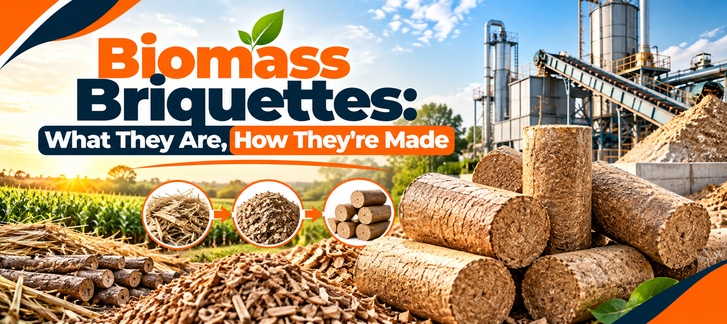
Biomass Briquettes: What They Are, How They're Made | ZAL
What biomass briquettes are, how they're made, what 1kg costs, who buys them in Pakistan, and where to source them at wholesale rates.

[Image: biomass-briquettes_2026-09-29_11-58-25.jpg]
Quick answer: You know what a biomass briquette actually is? Just waste, pressed together until it holds a shape. Sawdust, rice husk, whatever's left over that nobody wanted to deal with.

Enough pressure and it sticks together on its own, no glue involved. That's really the whole trick. People burn them instead of coal or firewood in factory boilers, brick kilns, even at home for heating.

Drive past a rice mill or a cotton gin almost anywhere in Punjab or Sindh, and there's usually a small mountain of husk or stalks sitting off to one side. Nobody quite knows what to do with it, so it just piles up.

A briquette press turns that pile into something a factory boiler can burn on a schedule instead of a fire hazard waiting for a match. The idea behind it is almost embarrassingly simple. Squeeze loose material hard enough, and it holds its own shape. But that one simple trick has quietly changed how a lot of small industry sources fuel across South Asia.

This piece covers what biomass briquettes are actually made from, how the manufacturing process works step by step, what they tend to cost, who's really buying them, and where you'd go looking for a supplier in Pakistan.

What Are Biomass Briquettes Made Of?

Definition: Almost any dry organic waste can go into a press, honestly. Rice husk, cotton stalks, groundnut shells, sugarcane bagasse, wheat straw. These are the usual suspects, and they're cheap for a boring reason: there's just a huge amount of them lying around after harvest season, with nowhere else to go.

Wood waste is the other big source. Sawdust, offcuts from sawmills, scraps from small furniture workshops, the kind of material that used to just get swept into a corner and set alight at the end of the week.

Coconut shells, coffee husk, and waste paper show up too, though less often in what's produced locally in Pakistan. They run through the same presses without any trouble.

None of this is interchangeable, though. What goes into the block decides two numbers a buyer will always ask about before agreeing to anything. Calorific value, or how much heat comes off per kilogram, and ash content, or how much is left over afterward that someone has to clean out.

Ask anyone who has actually bought fuel like this before. The first real question is never Do you have briquettes. It's what they're made from............Read More
Print this item