Posted by: zarea - 6 October 2026, 05:23 PM - Forum: Article - No Replies
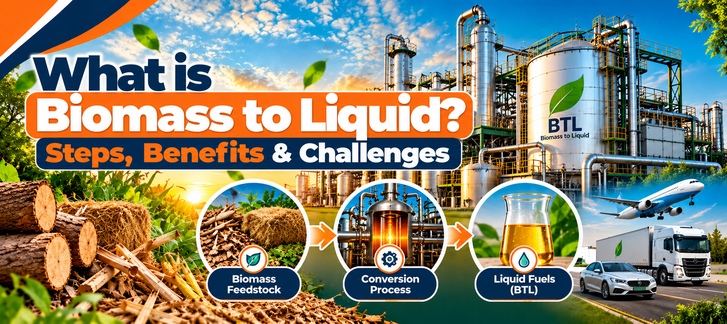
What is Biomass to Liquid? Steps, Benefits & Challenges
Discover the complete breakdown of biomass to liquid technology. Learn the crucial conversion steps, environmental benefits, and active industry challenges.
[Image: biomass-to-liquid-steps.jpg_2026-10-01_18-00-30.jpeg]
Introduction:

Imagine a world where we no longer drill into the Earth for crude oil purposes. Instead, we harvest yesterday’s wheat straws and even the morning’s municipal trash for fuel purposes. Or we use last week’s forest residue for this purpose. Then we convert them into clean and high-performance jet fuel and diesel. This isn't a futuristic dream; it is the reality of biomass to liquid fuel technology.

Traditional biofuels like corn ethanol are facing heavy scrutiny as the global push for net-zero carbon intensifies. Therefore, land usage and food supply conflict with each other. When we enter into the Biomass to Liquid (BtL) process, the thing goes in a different way. It's a sophisticated suite of thermochemical processes designed to transform non-edible organic matter into drop-in synthetic hydrocarbons.

Let’s break down exactly how this revolutionary technology works in different fields. What biomass to liquid can do? Because it changes real-world hurdles. So it must be cleared to change our energy landscape as well.

What is Biomass to Liquid Fuel (BTL)? BTL Process & Variants:

Biomass to Liquid is a process that converts solid organic materials into liquid hydrocarbons. Unlike a simple fermentation process. Because this process only utilizes sugars or starches present in the plant. While BTL relies on high-temperature thermochemical reactions. This allows it to break down the lignocellulose of the plant. It's the tough and structural cellular wall of plants that normal microbes cannot digest.

Therefore, since it can process the entire plant structure. Rather than just the edible portions of the plants. BTL represents a massive leap forward in biofuel efficiency and sustainability.

The Thermochemical Path of (BTL):

The premier and industry-standard route for producing synthetic fuel from biomass follows three steps. While these steps are distinct and tightly controlled phases of BTL.

[Solid Biomass] ➔ (Gasification) ➔ [Raw Syngas] ➔ (Cleaning/Conditioning) ➔ [Purified Syngas] ➔ (Fischer-Tropsch Synthesis) ➔ [Liquid Fuel]


Read More: https://zarea.com/news/what-is-biomass-t...challenges
Print this item
Posted by: nickdiaz - 6 October 2026, 05:18 PM - Forum: Article - No Replies
Video advertising on YouTube is not the same as running search campaigns. The creative work, the targeting options, the measurement approach, and the bidding strategies all differ. Professionals who assume their search experience carries over often find themselves lost. That reality explains why the Google Ads Video Professional Assessment Exam exists. It validates the specific skill set required to plan, run, and optimize video campaigns effectively.

What the Assessment Actually Measures

This is not a beginner certification. Google expects candidates to understand video advertising as a distinct discipline. The assessment covers campaign creation, audience targeting, creative formats, bidding strategies, and performance measurement within the YouTube ecosystem.

Candidates need to know how skippable in-stream ads differ from bumper ads. They need to understand how YouTube reach and frequency buying works compared to standard auction-based bidding. They need to explain when demand gen campaigns make sense and when brand awareness objectives fit better.

These are not memorization questions. They test whether someone can make sound decisions across different video campaign scenarios.
Campaign Strategy and Audience Targeting
Running video ads without a clear audience strategy wastes budget. The assessment tests whether candidates understand how to reach the right viewers through demographics, interests, custom intent audiences, and remarketing lists.

It also covers how to structure campaigns for different goals. A brand awareness campaign has different success metrics than a direct response campaign. The bidding strategy, creative approach, and measurement plan all change accordingly. Professionals who understand these distinctions can build campaigns that deliver actual results.

Creative and Format Knowledge

Video advertising lives or dies by the creative. The assessment expects candidates to understand format specifications, length recommendations, and how different ad types perform in different contexts.

They need to know when a six-second bumper ad works better than a thirty-second skippable ad. They need to understand how YouTube Shorts ads fit into the broader video strategy. They need to recognize that creative testing matters as much as targeting.
Measurement and Optimization
Knowing whether a campaign worked requires more than checking views. The assessment covers brand lift measurement, conversion tracking, and how to interpret metrics like view-through rate and cost per action.

Optimization skills matter here. Candidates need to understand how to adjust bids, refine audiences, and test creative variations based on performance data. A campaign that launches well can still fail without ongoing optimization.

For those preparing, working through Google Ads Video Professional Assessment Exam dumps helps candidates see how scenario-based questions test this decision-making ability rather than simple recall.

Why This Credential Has Value

Video advertising budgets keep growing. Advertisers want professionals who understand the format. The Google Ads Video Professional Assessment Exam gives employers a signal that someone has the structured knowledge to run video campaigns properly.

It does not replace hands-on campaign experience. It confirms that someone understands the platform, the strategy, and the measurement well enough to work effectively. For professionals who want to specialize in video advertising, this assessment puts their knowledge on record.
Print this item
Posted by: digitalin - 6 October 2026, 05:16 PM - Forum: Article - No Replies
Custom Website vs. Template Website: Which Is Right for Your Business?
Should you spend money on a custom website, or start with a ready-made template and grow later? It is one of the first questions every business owner asks, and the honest answer is that it depends on where your business is today.
Imagine two business owners who start the same week. One buys a ready-made design, adds a logo and goes live in four days. The other hires a team and waits three months for a site built from scratch. Who chose better? Either one could be right. The wrong choice is the one that does not fit your goals, your budget and your plans for the next two or three years.
In this guide, we compare a custom website and a template website on cost, speed, design, SEO, security and growth. We also share simple examples and a short checklist, so you can decide without guessing.

What Is a Custom Website?
A custom website is designed and built around your business, starting from a blank page. A designer plans the layout around how your customers think and buy. A developer writes the code so the site does exactly what you need, whether that is booking appointments, showing live prices or connecting to your billing software.
A good comparison is furniture. You can buy a ready-made wardrobe from a store, or you can ask a carpenter to build one that fits your wall exactly. The carpenter costs more and takes longer, but nothing is wasted and nothing sticks out.
Custom does not mean "no tools at all." Good teams still use proven frameworks like WordPress, Laravel or Next.js behind the scenes. What makes the site custom is that the design and features are made for you, not picked from a catalog.

What Is a Template Website?
A template website starts from a ready-made design. You pick a layout, add your logo, colors, text and photos, and publish. Templates come from website builders such as Wix, Squarespace and Shopify, and from WordPress theme stores. Some owners fill in the template themselves. Others pay a developer to adjust it.
A template website is not a bad website. Plenty of healthy businesses run on one. The limit is that someone else already decided the layout, the features and how pages behave, and you work inside those walls.

Cost: What You Really Pay for Each Option
Prices in India vary a lot. Guides from Indian agencies and hosting providers put a simple template-based site at anywhere from a few thousand rupees to roughly thirty thousand a year. A business website with a content management system often lands between fifty thousand and a couple of lakhs. Larger custom builds start around two lakh and can run into many lakhs. Treat these as rough pointers, not quotes, because the features you need change the price more than the label does.
The Hidden Costs of a Template Website
The low price on the box is rarely the full story. Watch for these:
•       Premium theme licenses that renew every year
•       Paid plugins for forms, bookings, SEO or security
•       Monthly platform fees that add up over the years
•       Developer hours when you need one small change the template does not allow
•       A full rebuild once the template can no longer keep up with the business

What Pushes a Custom Website Cost Up
A custom website costs more because people spend more hours on it. The price rises with the number of pages, the amount of design work, integrations with other software, special features like customer logins, and the testing needed to make it all work. Ongoing support and updates should also be part of the budget.
Think in Three Years, Not Three Days
A template website that costs little at the start can become the expensive option if you have to rebuild it after eighteen months. A custom website that costs more today can become the cheaper option if you never have to start over. So do not only compare the first invoice. Compare what each choice costs over the next three years, including your own time.

Speed to Launch
Here, the template website wins easily. A simple template site can be live within days, once you have your content ready. A custom website needs planning, design, development and testing, so it takes weeks or months, depending on size.
If you are running a limited-time offer, testing a new business idea or need something online before an event, speed matters. If you are building something that will sit at the centre of your sales for years, a few extra weeks at the start are usually a small price.

Design and Brand Identity
Example: Picture two dental clinics in the same city, both using the same popular template. Both have the same hero image layout, the same service icons and the same button style. A patient comparing them cannot tell them apart in five seconds. Neither clinic has told the patient why it is different.
That is the risk of a template website. Thousands of other sites may use the same base design. You can change colours and fonts, but the bones stay the same. A custom website lets your design carry your story, such as your process, your team and your promise, in a way that is yours alone.
If your brand depends on trust and a premium feel, like law, healthcare, finance or luxury services, this difference counts for more.
Features and Room to Grow
Templates are great at showing information: who you are, what you offer and how to contact you. They get harder to manage when you ask them to do more.
Example: A coaching institute starts with a simple template website. A year later, it wants online fee payment, student logins, batch-wise study material and automatic reminders on WhatsApp. Each wish needs another plugin. The plugins start to clash, the site slows down, and the owner spends more time fixing the site than teaching.
A custom website is built to hold those needs from the start, or at least to add them cleanly later. If you know your website will turn into an online store, a customer portal or a booking system, plan for custom early.

Website Speed and Core Web Vitals

Speed matters to visitors and to Google. Google measures it through Core Web Vitals. These look at how fast your main content loads (aim for under 2.5 seconds), how quickly the page responds when someone taps (under 200 milliseconds) and whether the layout jumps around while loading (a score under 0.1).
Many template websites ship with extra code for features you may never use, and every added plugin makes the page heavier. A custom website can be lean, because it carries only what it needs. But be fair to both sides: a badly built custom site can be slow, and a well-tuned template site can be fast. What matters is the quality of the work, not the label.

The Middle Option: A Customised Template

You do not have to pick one extreme. Many growing businesses start with a template website and then pay a developer to adjust the design, speed it up and add the specific features they need. This costs less than a full custom build and looks far less generic than a template used as it is.
It is a sensible path for a business that is still finding its feet. Just keep one rule in mind: if you find yourself paying for more and more changes to fight against the template, the money is probably better spent on a proper custom build.

Does a Custom Website Rank Better in Google?
Many articles say a custom website "naturally ranks better." That is too simple. Google does not give extra points for custom code. It rewards pages that are useful, quick to load, easy to use on a phone and easy for its crawlers to read.
A template website with a clean setup, good content and proper basics can rank well. Where a custom website helps is control. You can shape your URL structure, add the right structured data, build page layouts for large catalogs and remove anything that slows a page down. With a template, you may be limited by what the platform allows.
So, the honest answer is this: custom gives you more room to do SEO well, but it does not do the work for you. You still need good content and a clear site structure.
Security and Ownership
Template platforms are popular, which makes them a common target. Most hacks on template-based sites come from old themes and plugins that were never updated. If you choose a template website, keep everything updated and use only trusted plugins.
A custom website has a smaller footprint, but it is not safe by magic. It needs secure coding, regular updates and backups, like any software.
Also ask who owns what. On some website builders, you cannot take your site with you if you leave. With a custom build, make sure your contract says you own the code, the design files and the domain.

Which One Is Right for Your Business?
A Template Website Fits Best When
•       You are testing a new business idea and want to launch cheaply
•       You need basic pages such as home, about, services and contact
•       You have a small budget and a short timeline
•       You are comfortable updating the site yourself

A Custom Website Fits Best When
•       Your website is the main way you get customers or sales
•       You need special features, such as logins, calculators, bookings or integrations
•       Your brand needs to stand out from competitors who all look the same
•       You expect traffic and product pages to grow quickly
•       You deal with sensitive customer data and need tighter control
Example: A home baker taking orders through Instagram only needs a simple page with a menu and a WhatsApp button. A template website is perfect. A manufacturer selling to other businesses, with a product catalog, quote requests and a dealer login, is a different story. Squeezing that into a template will cost more in workarounds than a proper custom build would have.

Questions to Ask Before You Decide
1.      What is the main job of this website: information, leads or online sales?
2.      Which features do I need now, and which will I need in two years?
3.      How much can I spend now, and how much on upkeep every year?
4.      How quickly do I need to launch?
5.      Will I update the site myself, or will someone else?
6.      How important is it that my brand looks different from my competitors?
7.      If I outgrow this choice, how hard will it be to move?

Common Mistakes to Avoid
•       Choosing only by the first price, without counting plugins, renewals and rebuilds.
•       Paying for a large custom build when a simple site would do the job.
•       Skipping content planning. A great design cannot save thin or unclear pages.
•       Forgetting mobile visitors. Test on a real phone, not only on a laptop.
•       Not asking who owns the code, the design and the data.

Frequently Asked Questions 
What is the main difference between a custom website and a template website?
A custom website is designed and built from scratch for your business. A template website starts from a ready-made design that you adjust with your own logo, colors and content. Custom gives you more freedom. A template gives you more speed and a lower starting price.
Which is cheaper, a custom website or a template website?
A template website is cheaper to start. Over several years, the gap can shrink, because templates bring plugin fees, renewals and sometimes a rebuild. Compare the total cost over three years, not only the first bill.
Is a custom website better for SEO?
Not automatically. Google ranks useful, fast and easy-to-read pages, whatever the build. A custom website gives you more control over structure, speed and structured data, but you still need strong content. A well-set-up template website can rank well too.
Can I start with a template website and switch to a custom website later?
Yes, many businesses do. To make the move easier, keep your domain, save all your content and plan redirects from old pages to new ones, so you do not lose your search rankings.
How long does it take to build a custom website?
It depends on size and features. A small business site may take several weeks, while a larger site with special features can take a few months. A template website can go live in a few days once your content is ready.
Are template websites safe?
They can be, if you keep the theme and plugins updated and use trusted sources. Most problems come from old or unknown plugins, not from the idea of a template itself.
Do template websites load slower than custom websites?
Often they do, because themes carry extra code and many plugins. But it is not a rule. A well-tuned template site can be fast, and a badly built custom site can be slow. Test your page speed before and after you decide.
Is WordPress a template website or a custom website?
WordPress is a platform, so it can be either. If you install a ready-made theme and fill in your content, it is a template website. If a developer builds a theme and features just for you, it is a custom website that runs on WordPress.
Who owns my website, me or the platform?
It depends on how it was built. With some website builders, you cannot take the site with you. With a custom project, ownership comes from your agreement, so ask for the code, design files and domain to be in your name.
What type of business should choose a custom website?
Businesses that depend on their website for leads or sales, need special features like logins or bookings, sell in a crowded market, or expect fast growth usually gain the most from a custom website.
How much does a custom website cost in India?
Prices vary widely with the number of pages, design work, features and integrations. A simple business site costs far less than a portal or an online store with payments. Share your requirements with a development team and ask for a scoped quote that lists what is and is not included.

Final Thoughts
A template website is a smart start for a small budget and a simple message. A custom website is a smart investment when your site must do real work for your business. The mistake is not in picking either one. The mistake is picking without thinking about where you want your business to be in a few years.
Not sure which way to go? Tell us about your business, your budget and your goals, and our team will give you a straight answer, even if the answer is that you do not need a custom website yet. Contact Digital Innovations today to plan a website that fits your business now and grows with it.
Print this item
Posted by: titanaeratio - 6 October 2026, 05:10 PM - Forum: Blogger - No Replies
EPDM diffuser India is an important search term for industries, municipalities, wastewater treatment plants, engineering companies, and environmental solution providers looking for reliable aeration equipment. EPDM, or Ethylene Propylene Diene Monomer, is widely used as a membrane material in fine bubble diffusers because of its flexibility, durability, and resistance to many wastewater-treatment conditions.
We provide EPDM diffusers for wastewater treatment systems where efficient oxygen transfer, dependable operation, and long service life are essential. These diffusers can be used in sewage treatment plants (STPs), effluent treatment plants (ETPs), industrial wastewater facilities, municipal treatment plants, and aeration tanks.
A properly selected EPDM diffuser can help distribute air uniformly throughout an aeration basin. This improves contact between air bubbles and wastewater, supports biological treatment, and can contribute to efficient operation of the overall aeration system.
What Is an EPDM Diffuser?
An EPDM diffuser is an aeration device that transfers compressed air into wastewater through a flexible EPDM membrane. The membrane contains specially designed perforations that generate air bubbles when air is supplied through the diffuser.
Depending on the diffuser design, these bubbles can range from relatively coarse bubbles to fine bubbles. Fine bubble aeration is particularly useful when high oxygen-transfer efficiency is required.
An EPDM diffuser generally consists of:
  • EPDM membrane
  • Supporting diffuser body
  • Air distribution structure
  • Connection or mounting arrangement
  • Perforations or slits for air release
  • Clamps, fasteners, or other installation components
When the blower supplies air to the diffuser, pressure causes the membrane openings to release air into the water. When airflow stops, the flexible membrane can close the openings, helping reduce the possibility of wastewater entering the internal air distribution system.
Why Choose EPDM Diffusers in India?
Wastewater treatment conditions can vary considerably across India. Treatment plants may experience differences in wastewater composition, temperature, pH, suspended solids, organic loading, and operating schedules.
For this reason, aeration equipment needs to be selected according to the application rather than simply based on price.
EPDM membrane diffusers offer several characteristics that make them suitable for many wastewater applications.
  1. Flexible Membrane Construction
EPDM is an elastomeric material. Its flexibility allows the diffuser membrane to expand and contract as air pressure changes.
This flexibility is particularly useful in aeration systems that operate intermittently. When air is introduced, the membrane opens to release air. When airflow decreases or stops, the membrane returns toward its original position.
  1. Good Resistance to Environmental Conditions
EPDM is known for its resistance to weathering, ozone, and many environmental conditions. In wastewater applications, material selection is especially important because the diffuser remains submerged for extended periods.
The actual service life, however, depends on factors such as wastewater chemistry, operating conditions, air quality, temperature, cleaning practices, and diffuser design.
  1. Efficient Air Distribution
A properly designed EPDM fine bubble diffuser can distribute air through numerous small openings. This produces a large gas-liquid interface, allowing oxygen from the air to transfer into the wastewater.
Efficient distribution also helps provide oxygen to microorganisms responsible for biological treatment.
  1. Suitable for Continuous Operation
Many wastewater treatment plants operate continuously. Therefore, aeration components must be capable of functioning reliably for long operating periods.
EPDM diffusers can be incorporated into aeration grids designed for continuous or intermittent operation.
  1. Practical Maintenance
Diffuser systems should be designed with maintenance requirements in mind. Depending on the installation, diffuser elements may be accessible for inspection, cleaning, replacement, or periodic servicing.
Good maintenance practices can help preserve airflow performance and prevent unnecessary increases in blower energy consumption.
EPDM Fine Bubble Diffuser for STP Applications
A fine bubble diffuser for STP is used to supply oxygen to the biological treatment process. In activated sludge systems, microorganisms consume oxygen while breaking down biodegradable organic matter.
The aeration system therefore performs two important functions:
  1. It supplies oxygen required for biological activity.
  2. It helps maintain suitable mixing within the aeration basin.
An EPDM fine bubble diffuser can be installed across the bottom of an aeration tank to distribute air throughout the treatment zone.
The diffuser layout should be designed according to tank dimensions, required airflow, oxygen demand, water depth, diffuser density, and blower capacity.
EPDM Diffuser for ETP Applications
Industrial wastewater can contain complex contaminants and varying chemical loads. Therefore, an EPDM diffuser for ETP applications must be selected carefully.
Industries such as food processing, pharmaceuticals, textiles, chemicals, paper, dairy, and manufacturing may have significantly different wastewater characteristics.
We recommend evaluating:
  • Wastewater composition
  • pH range
  • Operating temperature
  • Organic loading
  • Chemical exposure
  • Suspended solids
  • Required oxygen demand
  • Airflow per diffuser
  • Tank depth
  • Blower pressure
  • Cleaning requirements
Material compatibility should always be verified against the actual wastewater before selecting an EPDM membrane diffuser for a specific industrial application.
How EPDM Fine Bubble Diffusers Work?
The operating principle is straightforward.
A blower produces compressed air and sends it through the air distribution piping. The air then enters the diffuser assembly installed at the bottom of the aeration tank.
As pressure builds beneath the EPDM membrane, air passes through the diffuser openings and forms bubbles.
The bubbles travel upward through the wastewater. During this movement, oxygen transfers from the air into the liquid.
The effectiveness of oxygen transfer depends on several factors, including:
  • Bubble size
  • Water depth
  • Airflow rate
  • Wastewater characteristics
  • Temperature
  • Diffuser submergence
  • Membrane condition
  • Tank geometry
  • Air distribution uniformity
Consequently, selecting a diffuser should be part of an overall aeration system design, rather than an isolated equipment decision.
Advantages of EPDM Membrane Diffusers
An appropriately designed EPDM diffuser system can provide several operational advantages.
High Surface Area for Oxygen Transfer
Fine bubbles provide a large surface area relative to their volume. This can improve the opportunity for oxygen to transfer into wastewater.
Uniform Aeration
Correctly spaced diffusers can provide relatively uniform air distribution throughout an aeration basin.
Flexible Membrane
The flexible EPDM membrane responds to changes in air pressure and can support reliable air release during operation.
Wide Application Range
EPDM diffusers can be considered for many municipal and industrial wastewater applications, subject to material compatibility.
Potential Energy Savings
Aeration is often one of the largest energy-consuming processes in a biological wastewater treatment plant. Efficient oxygen transfer can help reduce the amount of air required for a particular oxygen demand.
However, actual energy savings depend on the complete aeration system, including blower efficiency, diffuser performance, tank depth, control strategy, and operating conditions.
EPDM Disc Diffuser vs. EPDM Tube Diffuser
Two common configurations are disc diffusers and tube diffusers.
EPDM Disc Diffuser
Disc diffusers are circular membrane diffusers generally installed on a support body connected to the air distribution system.
They can be suitable for:
  • Aeration tanks
  • Activated sludge systems
  • Municipal STPs
  • Industrial ETPs
  • Biological treatment systems
Disc diffuser systems can provide a broad aeration area when installed in suitable quantities and layouts.
EPDM Tube Diffuser
Tube diffusers use an elongated membrane mounted around a tubular support structure. The larger membrane length can provide an extended air-release surface.
They may be useful where the aeration layout benefits from elongated diffuser elements.
The choice between disc and tube configurations should be based on tank geometry, airflow requirements, installation arrangement, maintenance accessibility, and overall system design.
Print this item