Posted by: sairramyadav - 15 October 2026, 11:35 AM - Forum: Article - Replies (1)
In today’s competitive business environment, accounting is no longer limited to maintaining financial records, filing taxes, and meeting statutory deadlines. It has evolved into a strategic business function that influences decision-making, operational efficiency, profitability, and long-term growth.

For businesses of all sizes, effective financial management can make the difference between simply meeting obligations and building a sustainable, scalable organization. While financial compliance remains essential, forward-thinking businesses are increasingly recognizing the value of using accounting as a tool for business intelligence, planning, and growth.

This shift from compliance-focused accounting to growth-oriented financial management is central to a smarter approach to accounting.

Understanding the Changing Role of Accounting

Traditionally, businesses viewed accounting primarily as a back-office function responsible for recording transactions, preparing financial statements, managing payroll, and ensuring tax compliance. Although these activities remain fundamental, they represent only one part of the larger financial management process.

Modern businesses need more than accurate records. They need timely financial information that helps them understand their performance, identify risks, control costs, and make informed decisions.

For example, a business may generate strong revenue but still experience cash flow difficulties because of delayed customer payments, rising operating expenses, or poor working capital management. Without meaningful financial analysis, these issues may remain unnoticed until they begin affecting business operations.

A smarter approach to accounting connects financial data with business objectives. It enables business owners and management teams to understand not only what has happened financially, but also why it happened and what actions they can take next.

Financial Compliance: The Foundation of Sustainable Growth

Financial compliance is a critical responsibility for every business. Maintaining accurate books, meeting tax obligations, processing payroll correctly, and complying with applicable financial regulations help organizations operate responsibly and reduce avoidable risks.

However, compliance should not be treated as an isolated activity or a task that receives attention only when a deadline approaches.

A well-organized accounting system creates a reliable financial foundation for the entire business. When records are maintained consistently and financial information is readily available, organizations can prepare for audits, respond to regulatory requirements, monitor obligations, and reduce the likelihood of errors.

For businesses operating across different markets, compliance can become more complex. Different jurisdictions may have distinct tax rules, reporting requirements, payroll obligations, and documentation standards. Understanding these differences and establishing appropriate processes is essential for maintaining financial discipline.

The real opportunity lies in building compliance into everyday financial operations rather than treating it as a periodic burden. This allows businesses to spend less time correcting errors and more time focusing on strategic priorities.

Turning Accounting Data into Business Intelligence

One of the most important developments in modern accounting is the growing role of financial information in strategic decision-making.

Financial reports contain valuable insights into a company's performance, but those insights become useful only when they are interpreted and applied effectively.

Business owners should regularly evaluate key financial indicators, including:

● Revenue and profitability: Understand which products, services, or business segments contribute most to overall performance.
● Cash flow: Monitor incoming and outgoing funds to ensure the business can meet its short-term financial commitments.
● Operating expenses: Identify unnecessary costs, spending patterns, and opportunities to improve efficiency.
● Accounts receivable and payable: Manage collections and payment schedules to maintain healthy working capital.
● Budget versus actual performance: Compare financial results with business plans to identify gaps and take corrective action.
● Financial forecasts: Use historical data and current business conditions to support future planning.

These insights can help organizations make better-informed decisions about pricing, hiring, expansion, investment, and resource allocation.

Accounting becomes significantly more valuable when it moves beyond explaining past transactions and starts helping businesses prepare for future opportunities.

The Importance of Cash Flow and Financial Discipline

Profitability and cash flow are closely related, but they are not the same. A business can report a profit while struggling to pay salaries, suppliers, rent, or other operating expenses.

This often occurs when too much capital is tied up in unpaid invoices, inventory, or other working capital requirements.

A smarter accounting approach prioritizes regular cash flow monitoring, timely invoicing, effective collections, expense planning, and realistic financial forecasting.

Businesses should understand when cash is expected to arrive, when payments are due, and how much working capital is required to support day-to-day operations.

Financial discipline also involves establishing budgets, reviewing spending patterns, and evaluating major expenses against expected business outcomes. These practices help businesses respond more effectively to unexpected challenges while creating a stronger foundation for expansion.

Technology and Automation: Making Accounting More Efficient

Technology is transforming the way businesses manage their financial operations. Cloud-based accounting platforms, automated bank reconciliations, digital invoicing, payroll systems, and financial reporting tools can reduce manual work and improve access to financial information.

When implemented appropriately, automation can help organizations minimize repetitive tasks, maintain more consistent records, and identify discrepancies earlier.

It can also improve collaboration between business owners, internal finance teams, and external accounting professionals, particularly when operations span multiple locations.

However, technology alone does not guarantee better financial management. Businesses must select suitable systems, establish clear workflows, maintain appropriate access controls, and review the accuracy of financial information.

Human expertise remains important for interpreting financial results, addressing unusual transactions, understanding regulatory requirements, and translating accounting information into practical business recommendations.

The most effective approach combines technology, professional knowledge, and well-defined financial processes.

Outsourcing Accounting: A Strategic Business Decision

As businesses grow, their accounting requirements often become more demanding. Managing bookkeeping, payroll, taxation, reconciliations, reporting, and compliance internally can consume significant time and resources.

For small and medium-sized enterprises, maintaining a complete in-house finance department may not always be practical. Outsourcing accounting functions can provide access to specialized expertise and structured financial processes without requiring the same level of internal infrastructure.

A professional accounting partner can support businesses with:

● Bookkeeping and financial record maintenance.
● Accounts payable and accounts receivable management.
● Payroll processing and related reporting.
● Tax preparation and compliance support.
● Bank and account reconciliations.
● Periodic financial statements and management reports.
● Financial planning support and performance analysis.

Outsourcing can help business owners establish consistent accounting routines, improve reporting timelines, and redirect internal resources toward core business activities.

The key is to select a service provider that understands the organization's industry, operating model, reporting expectations, and applicable compliance requirements. Clear communication, data security, defined responsibilities, and regular performance reviews are equally important.

Supporting Businesses Across Different Markets

Businesses operating internationally face additional financial management challenges. Differences in tax systems, reporting standards, payroll requirements, currencies, and business practices can create complexity for organizations working across borders.

A structured accounting framework helps businesses maintain consistency while addressing the requirements of the markets in which they operate.

For companies working across the United States and India, effective coordination of accounting records, payroll processes, taxation support, and financial reporting can improve visibility into business performance and support better operational control.

International accounting support is not simply about completing financial tasks in different locations. It also involves establishing dependable processes, maintaining clear documentation, and ensuring that management has access to meaningful financial information.

With the right systems and professional support, businesses can approach cross-border operations with greater confidence and a clearer understanding of their financial position.

From Compliance to Growth: Building a Smarter Accounting Strategy

Moving toward growth-oriented accounting does not necessarily require a complete overhaul of existing systems. Businesses can begin by strengthening the fundamentals and gradually introducing more strategic financial practices.

1. Establish accurate and consistent financial records. Ensure that transactions are recorded promptly, accounts are reconciled regularly, and financial documents are organized.

2. Create a predictable reporting cycle. Review financial performance monthly rather than waiting until the end of the financial year. Timely reporting helps management identify problems and opportunities earlier.

3. Monitor key financial metrics. Track the indicators that matter most to the business, including cash flow, gross margins, operating costs, outstanding receivables, and profitability.

4. Introduce budgeting and forecasting. Develop realistic budgets and update forecasts as business conditions change. This supports more informed decisions about expenditure, hiring, and expansion.

5. Use technology thoughtfully. Automate repetitive processes where practical while maintaining appropriate checks, reconciliations, and oversight.

6. Seek professional financial guidance. Work with qualified professionals who can help interpret financial information, identify potential risks, and support compliance and planning.

7. Align accounting with business goals. Ensure that financial reporting supports the organization's priorities, whether those involve improving profitability, expanding into new markets, strengthening cash flow, or scaling operations.

Together, these steps can transform accounting from a routine administrative responsibility into a more proactive part of business management.

A Leadership Perspective: Accounting as a Business Enabler

The relationship between finance and business growth is particularly important for entrepreneurs and business leaders who must balance operational demands with long-term strategic objectives.

Avula Sai Ram Yadav is a finance professional, entrepreneur, and business leader with experience across accounting, taxation, consulting, and business management. A semi-qualified Chartered Accountant with a Bachelor’s degree in Commerce and an LLB, he founded Accounting For Sure in 2014 to provide businesses with accounting, bookkeeping, payroll, taxation, and related financial services.

Through Accounting For Sure, he has developed a professional services business supporting clients in the United States and India. His work reflects the importance of dependable financial processes and adaptable accounting support for businesses operating in different commercial environments.

In addition to founding Accounting For Sure, he serves as Managing Director of Expanovate Consulting Services Pvt. Ltd. and is the founder of Finstreak, SpotAMeet, and Skilltorole.

His entrepreneurial journey spans finance, professional services, consulting, and business development. Initiatives such as Indian Venture Labs can be considered within the broader entrepreneurial ecosystem, where business planning, financial discipline, and strategic decision-making are important considerations for developing sustainable ventures.

Across these professional and entrepreneurial activities, effective financial management remains an important consideration for building structured operations, allocating resources, evaluating opportunities, and supporting sustainable business objectives.

Financial Management and the Entrepreneurial Growth Journey

For emerging businesses, financial management is closely connected to growth planning, resource allocation, and operational sustainability. The entrepreneurial ecosystem, including organizations and initiatives such as Indian Venture Labs, reflects the wider importance of creating a structured approach to business development.

Entrepreneurs can strengthen their financial foundations by maintaining accurate records, monitoring cash flow, setting realistic budgets, and reviewing performance regularly. These practices can help identify financial challenges early, improve accountability, and support more informed decisions about expansion.

Accounting also helps business leaders evaluate whether their growth plans are financially sustainable. By understanding operating costs, margins, capital requirements, and future cash flow, businesses can make more considered decisions about hiring, investing, and entering new markets.

Integrating financial discipline into business planning allows entrepreneurs to move beyond short-term financial management and focus on building resilient, scalable organizations.

The Future of Accounting: More Strategic, More Connected

The future of accounting will increasingly depend on the integration of reliable financial processes, digital tools, analytical capabilities, and professional judgment.

Routine activities will continue to benefit from automation, while the interpretation of financial information and its application to business decisions will remain valuable areas of professional expertise.

Businesses will increasingly expect their accounting systems to provide timely insights, support planning, improve financial visibility, and help management respond to changing market conditions.

This does not reduce the importance of compliance. Instead, it strengthens its role as the foundation upon which better financial management and sustainable growth can be built.

Organizations that invest in accurate records, efficient processes, appropriate technology, and informed financial guidance will be better positioned to understand their performance and prepare for future challenges.

Conclusion

Accounting is most effective when it does more than satisfy regulatory requirements. Accurate bookkeeping, timely tax compliance, dependable payroll, and organized financial reporting are essential, but they also create the foundation for stronger business decisions.

By combining compliance with cash flow management, financial analysis, automation, forecasting, and professional expertise, businesses can develop a smarter approach to accounting—one that supports both operational stability and long-term growth.

For entrepreneurs and growing organizations, the objective should be clear: move beyond simply recording financial activity and start using financial information to guide the business forward.

As demonstrated by Avula Sai Ram Yadav through his entrepreneurial and professional journey, financial expertise and structured business management can work together to help organizations build stronger operational foundations.
Print this item
Posted by: Tifny - 15 October 2026, 11:18 AM - Forum: Article - No Replies
Affiliate marketing strategies help businesses promote their products and services through individuals or partners who earn commissions for generating sales, leads, or website traffic. An effective affiliate marketing strategy begins with identifying the target audience and selecting the right affiliate partners whose content and interests align with the brand. Businesses can collaborate with bloggers, social media influencers, content creators, and niche website owners to reach potential customers and increase brand awareness. Creating high quality content such as product reviews, comparison articles, tutorials, videos, and buying guides helps affiliates build trust and encourage customers to make informed purchasing decisions. Search engine optimization is another important strategy because it improves the visibility of affiliate content in search results and attracts organic traffic. Social media platforms such as Instagram, YouTube, Facebook, and Pinterest can also help affiliates promote products and connect with relevant audiences. Email marketing allows affiliates to share product recommendations, exclusive offers, and useful  digital marketing agency in kerala information with subscribers who have already shown interest in a particular niche. Choosing profitable products with competitive commission rates and reliable tracking systems is essential for long term success. Businesses should provide affiliates with promotional materials, product information, discount codes, and timely support to improve campaign performance. Tracking important metrics such as click through rates, conversion rates, sales, and return on investment helps marketers understand which strategies deliver the best results. Using analytics tools enables affiliates to identify successful campaigns, improve weak content, and make data driven decisions. Building strong relationships with affiliate partners can lead to consistent promotion and sustainable business growth. Transparency is equally important, as affiliates should clearly disclose their commercial relationships and provide honest product recommendations to maintain audience trust and comply with applicable advertising regulations. Marketers should also avoid promoting low quality products simply because they offer higher commissions. Instead, focusing on customer needs, product relevance, and genuine value creates better long term results. Testing different promotional methods, optimizing landing pages, and adapting to changing consumer preferences can further improve campaign effectiveness. By combining quality content, audience targeting, ethical promotion, performance tracking, and continuous optimization, businesses and individual marketers can develop successful affiliate marketing strategies that increase revenue, strengthen customer relationships, and support sustainable digital growth.
Improve paragraph readabilityAdd clear strategy subheadings
Print this item
Posted by: phudatvuong - 15 October 2026, 10:26 AM - Forum: Article - No Replies
Sử dụng biến tần cho quạt hướng trục công nghiệp: Khi nào nên áp dụng?
Trong nhà xưởng, nhu cầu thông gió có thể thay đổi theo số lượng máy móc hoạt động, nhiệt lượng phát sinh hoặc từng ca sản xuất. Nếu quạt hướng trục luôn chạy ở tốc độ cố định, hệ thống có thể tiêu thụ nhiều điện hơn mức cần thiết trong những thời điểm nhu cầu trao đổi khí giảm.
Biến tần cho phép điều chỉnh tốc độ động cơ trong phạm vi phù hợp, giúp hệ thống linh hoạt hơn khi điều kiện vận hành thay đổi. Tuy nhiên, hiệu quả thực tế phụ thuộc vào loại động cơ, đặc tính quạt và cách điều khiển được thiết kế.

[Image: images?q=tbn:ANd9GcSymAPFjo9OcVeoSrrp4Fx...atuDQ&s=10]

Biến tần điều khiển quạt hướng trục như thế nào?
Biến tần thay đổi tần số nguồn điện cấp cho động cơ xoay chiều để điều chỉnh tốc độ quay. Khi tốc độ thay đổi, đặc tính lưu lượng và áp suất của quạt cũng thay đổi theo.
Với quạt hướng trục hoạt động trong điều kiện phù hợp, giảm tốc độ có thể giúp giảm đáng kể công suất tiêu thụ. Tuy vậy, mức tiết kiệm không cố định cho mọi hệ thống và cần được đánh giá tại điểm vận hành thực tế.

Điều chỉnh tốc độ theo nhu cầu thông gió
Ở khu vực sản xuất có tải nhiệt thay đổi theo thời gian, quạt có thể chạy ở tốc độ cao khi nhu cầu thông gió lớn và giảm tốc độ khi nhu cầu thấp hơn. Cách vận hành này giúp hạn chế tình trạng duy trì lưu lượng quá mức cần thiết.
Mức điều chỉnh phải bảo đảm vẫn đáp ứng yêu cầu trao đổi khí, làm mát hoặc kiểm soát chất ô nhiễm. Không nên giảm tốc độ chỉ để tiết kiệm điện nếu điều đó làm ảnh hưởng đến điều kiện làm việc an toàn.

Những hệ thống nào phù hợp để sử dụng biến tần?
Biến tần thường đáng cân nhắc ở những hệ thống có nhu cầu thông gió thay đổi rõ rệt và động cơ phù hợp với phương pháp điều khiển này.

Nhà xưởng vận hành theo nhiều ca
Trong một số nhà máy, lượng nhiệt phát sinh thay đổi theo số lượng dây chuyền đang hoạt động. Điều chỉnh tốc độ quạt theo nhu cầu có thể giúp tránh chạy hết công suất trong thời gian tải thấp.

Hệ thống thông gió có cảm biến
Quạt có thể được tích hợp với cảm biến nhiệt độ hoặc các thiết bị đo phù hợp để điều chỉnh tốc độ tự động. Với khu vực cần kiểm soát chất lượng không khí, cảm biến và thuật toán điều khiển phải được lựa chọn theo chỉ tiêu cần giám sát, chẳng hạn nồng độ khí hoặc áp suất trong phòng.
Cần lưu ý rằng cảm biến nhiệt độ không thể thay thế thiết bị đo chất ô nhiễm khi hệ thống có yêu cầu kiểm soát khí độc hoặc bụi nguy hại.
Xem thêm: Chi phí vòng đời quạt hướng trục: Cách đánh giá hiệu quả đầu tư

[Image: images?q=tbn:ANd9GcSBrmvlTfubNONlJ8RzFJz...zAJeQ&s=10]

Các yếu tố cần kiểm tra trước khi lắp biến tần
Không phải mọi động cơ quạt hướng trục đều có thể kết nối với biến tần mà không cần đánh giá kỹ thuật. Trước khi triển khai, doanh nghiệp nên kiểm tra một số yếu tố quan trọng.

Khả năng tương thích của động cơ
Cần xác định loại động cơ, điện áp, dòng điện định mức và khả năng vận hành với biến tần. Một số động cơ cần được xem xét thêm về cách làm mát, giới hạn tốc độ và điều kiện cách điện khi điều khiển bằng biến tần.

Giới hạn tốc độ của quạt
Giảm tốc độ quá thấp có thể khiến lưu lượng không đáp ứng yêu cầu. Ngược lại, tăng tốc độ vượt giới hạn thiết kế có thể làm tăng tải cơ học, rung động và nguy cơ hư hỏng.
Vì vậy, dải điều chỉnh phải nằm trong giới hạn cho phép của cả động cơ lẫn cụm quạt, đồng thời phù hợp với đường đặc tính hệ thống.

Hệ thống điện và bảo vệ
Biến tần cần được lựa chọn theo thông số động cơ và điều kiện làm việc. Tủ điện phải có phương án bảo vệ, nối đất và thông gió phù hợp; việc lắp đặt nên do người có chuyên môn thực hiện theo hướng dẫn của nhà sản xuất.

Những sai lầm dễ làm giảm hiệu quả khi dùng biến tần
Một lỗi thường gặp là lắp biến tần nhưng không điều chỉnh chế độ điều khiển theo nhu cầu thực tế. Nếu quạt vẫn chạy gần tốc độ tối đa trong phần lớn thời gian, mức tiết kiệm điện có thể không đáng kể.
Một vấn đề khác là giảm tốc độ quá mức khiến không khí không được trao đổi đầy đủ. Với hệ thống hút khí tại khu vực phát sinh nhiệt, bụi hoặc hơi hóa chất, cần bảo đảm lưu lượng tối thiểu theo yêu cầu thiết kế.
Ngoài ra, doanh nghiệp không nên chỉ dựa vào phần trăm tốc độ để suy ra chính xác lượng điện tiết kiệm. Hiệu quả còn phụ thuộc vào đặc tính quạt, sức cản đường dẫn, hiệu suất động cơ và chế độ tải. Đo đạc trước và sau khi điều chỉnh sẽ giúp đánh giá đáng tin cậy hơn.

Quạt Phú Đạt Vượng hỗ trợ lựa chọn giải pháp thông gió
Khi cân nhắc sử dụng biến tần cho quạt hướng trục, doanh nghiệp cần đánh giá đồng thời nhu cầu lưu lượng, điều kiện vận hành và khả năng tương thích của động cơ. Quạt Phú Đạt Vượng cung cấp các giải pháp quạt công nghiệp phục vụ nhà xưởng, kho hàng và khu vực sản xuất, hỗ trợ doanh nghiệp lựa chọn thiết bị phù hợp với yêu cầu thực tế.
Kết hợp đúng loại quạt với phương án điều khiển phù hợp giúp hệ thống chủ động hơn trước sự thay đổi của nhu cầu thông gió, đồng thời tạo cơ sở để kiểm soát điện năng hiệu quả.
Print this item
Posted by: Baditgv - 15 October 2026, 10:23 AM - Forum: Article - No Replies
Slickorps vs Fusion Markets: A Comprehensive Comparison of CFD Trading Platforms

[Image: p9ihro8c.png]

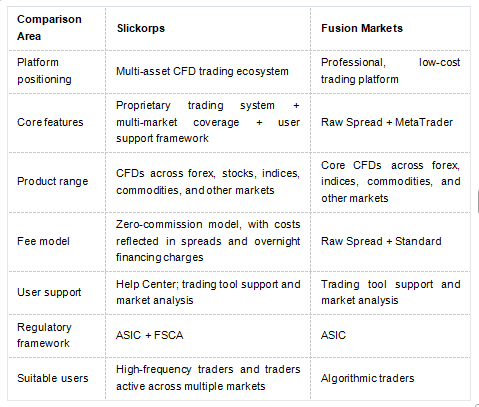
Slickorps and Fusion Markets both offer CFD trading services, but their platform positioning differs. Fusion Markets places greater emphasis on low-cost trading, Raw Spread accounts, and the MetaTrader trading ecosystem, while Slickorps positions itself as a multi-asset CFD trading platform covering forex, stocks, indices, commodities, and other market categories.
 
This article compares Slickorps and Fusion Markets across product features, trading experience, fee structures, account models, risk management, and regulatory frameworks to help traders understand the characteristics of different CFD platforms. The analysis is based on publicly available information and is intended solely for market information purposes. It does not constitute investment advice.
 
Key Differences at a Glance

[Image: zyndpemh.png]

1. Platform Overview
 
Introduction to Slickorps
 
Slickorps is a global multi-asset CFD trading platform offering contracts for difference across several market categories, including forex, stocks, indices, and commodities.
 
Through web-based and mobile trading access, the platform enables users to access different asset classes through a single account. Slickorps has developed a user service framework around trading, fund management, risk control, and educational support. In addition to trading features, the platform provides a Help Center and the Slickorps Academy educational program to help users understand account opening procedures, account management, trading operations, and CFD fundamentals.
 
In terms of its regulatory framework, Slickorps operates through entities in different jurisdictions. SLICKORPS TRADE PTY LTD holds an Australian Financial Services Licence, AFSL 565483, while the South African operating entity holds FSCA authorization under FSP 54545. Regulatory requirements, service scope, and client terms may vary between entities. Please refer to the official disclosures from the relevant entity for specific details.
 
Introduction to Fusion Markets
 
Fusion Markets is a platform focused on forex and CFD trading services.
 
The platform centers on a low-cost trading environment and offers two account models: Raw Spread and Standard. Raw Spread accounts use a low-spread, commission-based structure, while Standard accounts operate on a commission-free basis.
 
Fusion Markets supports trading platforms such as MT4, MT5, and cTrader, providing tools for automated trading, technical indicators, and strategy-based trading. Its development focus leans toward optimizing the professional trading environment, making it suitable for users who prioritize trading costs and the MetaTrader ecosystem.
 
2. Products and Features
 
Slickorps
 
Slickorps offers more than 1,000 CFD products across forex CFDs, stock CFDs, index CFDs, and commodity CFDs.
 
Forex CFDs: Provide trading opportunities in major currency pairs, allowing users to trade on movements in global exchange rates.
Stock CFDs: Cover popular stock markets worldwide, allowing users to trade on price movements without owning the underlying shares.
Index CFDs: Enable traders to trade on movements in major global stock indices.
Commodity CFDs: Include popular markets such as gold and crude oil.
 
Compared with platforms focused on a single market, multi-asset coverage allows traders to adjust their strategies to different market conditions. Access to multiple markets through one account can help reduce the need to switch between platforms and improve trading efficiency.
 
Fusion Markets
 
Fusion Markets primarily focuses on forex, indices, commodities, and selected stock CFDs and other CFD products. The platform supports MT4, MT5, and cTrader, with tools for Expert Advisor (EA) automated trading, custom indicators, and algorithmic strategies.
 
Its strength lies less in the number of products available and more in cost optimization for core trading instruments. For users who primarily trade instruments such as EUR/USD, gold, and indices, this model is more closely aligned with the needs of professional short-term trading.
 
3. Trading Experience
 
Slickorps
 
Slickorps provides web-based and mobile trading access. Users can view market prices, manage accounts, and execute trades through a browser or mobile app. The platform supports real-time quotes, technical indicator analysis, risk management tools, and stop-loss functionality.
 
Users can find trading instruments through the platform search function and perform actions such as opening positions, placing pending orders, and closing positions. For traders who want to manage multiple asset classes within a single interface, this integrated experience may better meet their needs.
 
Fusion Markets
 
Fusion Markets supports MT4, MT5, and cTrader. These platforms are widely used among traders and support EA automated trading, custom indicators, and algorithmic strategies. They are suitable for professional traders and those familiar with the MetaTrader ecosystem.
 
4. Account Models and Trading Costs
 
Slickorps
 
Slickorps does not charge trading commissions. Trading costs are primarily reflected in spreads and overnight financing charges. The cost structure is straightforward, with no separate commission calculation required, making actual trading costs easier to understand. This model is suitable for general traders, low- to medium-frequency traders, and users who prefer a simple trading model.
 
Fusion Markets
 
Fusion Markets offers two account types.
 
Raw Spread account: Features lower spreads plus a separate commission, making it suitable for high-frequency trading, EA trading, and professional traders.
 
Standard account: Features no separate commission, with costs incorporated into the spread, making it suitable for traders who prefer a straightforward, commission-free model.
 
Traders need to calculate the actual cost—spread plus commission—rather than focus solely on a quoted spread of 0.0. Neither model is inherently better than the other; the choice depends on trading frequency and cost preferences.
 
5. Order Execution and Risk Management
 
Slickorps supports multi-asset trading through intelligent order execution, market data analysis, and risk exposure monitoring. The platform focuses on margin management and anomaly detection to help users control risk in volatile market conditions. It also provides a negative balance protection mechanism, allowing eligible accounts to avoid negative balances.
 
Fusion Markets works with multiple liquidity providers to offer low-latency execution and support an ECN environment. The platform emphasizes execution efficiency for major forex instruments and indices, making it suitable for short-term and high-frequency traders.
 
The two platforms place different emphases on trade execution and risk management. Traders can assess them based on their trading frequency and preferred instruments.
 
6. User Support Framework
 
Slickorps has developed a comprehensive user support framework. The Help Center covers several areas, including account setup, account and fund management, the trading platform, trading operations, risk control, fees and charges, and fund security.
 
· Account setup: Includes account registration, identity verification, and KYC review. After registering, users need to provide the required information and complete identity verification.
· Fund management: Includes deposits, withdrawals, and access to transaction records. The platform supports bank cards, bank transfers, and other payment methods, with specific options varying by region.
· Trading operations: Includes guidance on common actions such as placing market orders and pending orders, closing positions, and modifying orders.
· Risk control: Includes explanations of mandatory position close-out mechanisms, negative balance protection, and slippage.
 
Fusion Markets also provides multilingual customer support and maintains its own educational section, including trading guides and market analysis.
 
7. Regulation and Client Fund Security
 
Slickorps
 
Slickorps operates through entities in different jurisdictions. SLICKORPS TRADE PTY LTD holds Australian Financial Services Licence AFSL 565483, while the South African operating entity holds FSCA authorization under FSP 54545. Client funds are managed in accordance with applicable regulatory requirements, held in segregated trust accounts, and not used for company operations.
 
Fusion Markets
 
Fusion Markets holds Australian ASIC licence AFSL 385620 and is subject to the ASIC regulatory framework for retail clients. ASIC imposes leverage limits for retail clients and requires client funds to be held separately. Fusion Markets holds client funds in trust accounts with major Australian banks, separate from company operating funds.
 
When choosing a platform, traders should confirm the entity with which they enter into an agreement when opening an account, rather than relying solely on the brand name.
 
Who Is Fusion Markets Suitable For?
If your trading approach has the following characteristics, Fusion Markets may better meet your needs:
 
· You pay close attention to every component of trading costs
· You primarily trade forex
· You use EAs or algorithmic trading
· You are familiar with MetaTrader or cTrader
 
The Raw Spread accounts and MetaTrader ecosystem available through Fusion Markets provide these traders with a familiar trading environment and cost structure.
 
Who Is Slickorps Suitable For?
If the following characteristics apply to you, Slickorps may be a better fit:
· You want to trade multiple markets through one account
· You focus on stock, index, and commodity CFDs
· You prefer a straightforward cost structure without calculating commissions separately
· You want a comprehensive user support framework and structured educational content
 
The multi-asset coverage, zero-commission account model, Help Center, and Slickorps Academy educational program provide support for traders who want to explore multiple market categories and learn systematically. Slickorps serves different clients through entities in different jurisdictions, so traders need to confirm the entity and regulatory requirements applicable to them.
 
Conclusion: Two CFD Platform Models, Neither Inherently Superior
Slickorps and Fusion Markets represent two different development paths within the CFD industry.
 
For users who primarily engage in short-term forex trading and rely on EAs or MetaTrader tools, the Fusion Markets model may be a closer fit. For users who want to trade across forex, stocks, indices, and commodities and value an integrated trading experience and ongoing learning resources, Slickorps offers an alternative.
 
The final choice should be based on a combined assessment of trading instruments, cost structure, platform features, and the applicable regulated entity. Traders are advised to first use a demo account to explore platform features and trading conditions, then make a choice based on their own needs.
 
Risk Warning
CFDs are leveraged financial products, and price fluctuations may result in a loss of invested capital. This article is intended solely for market observation and informational purposes and does not constitute investment advice of any kind. Traders should make trading decisions cautiously after fully understanding the product characteristics, associated risks, and their own risk tolerance. Past performance is not indicative of future results.
[url=https://jpcdn.it/img/d42363db4d1e97139e7fa60f046db9c7.png][/url]
Print this item